
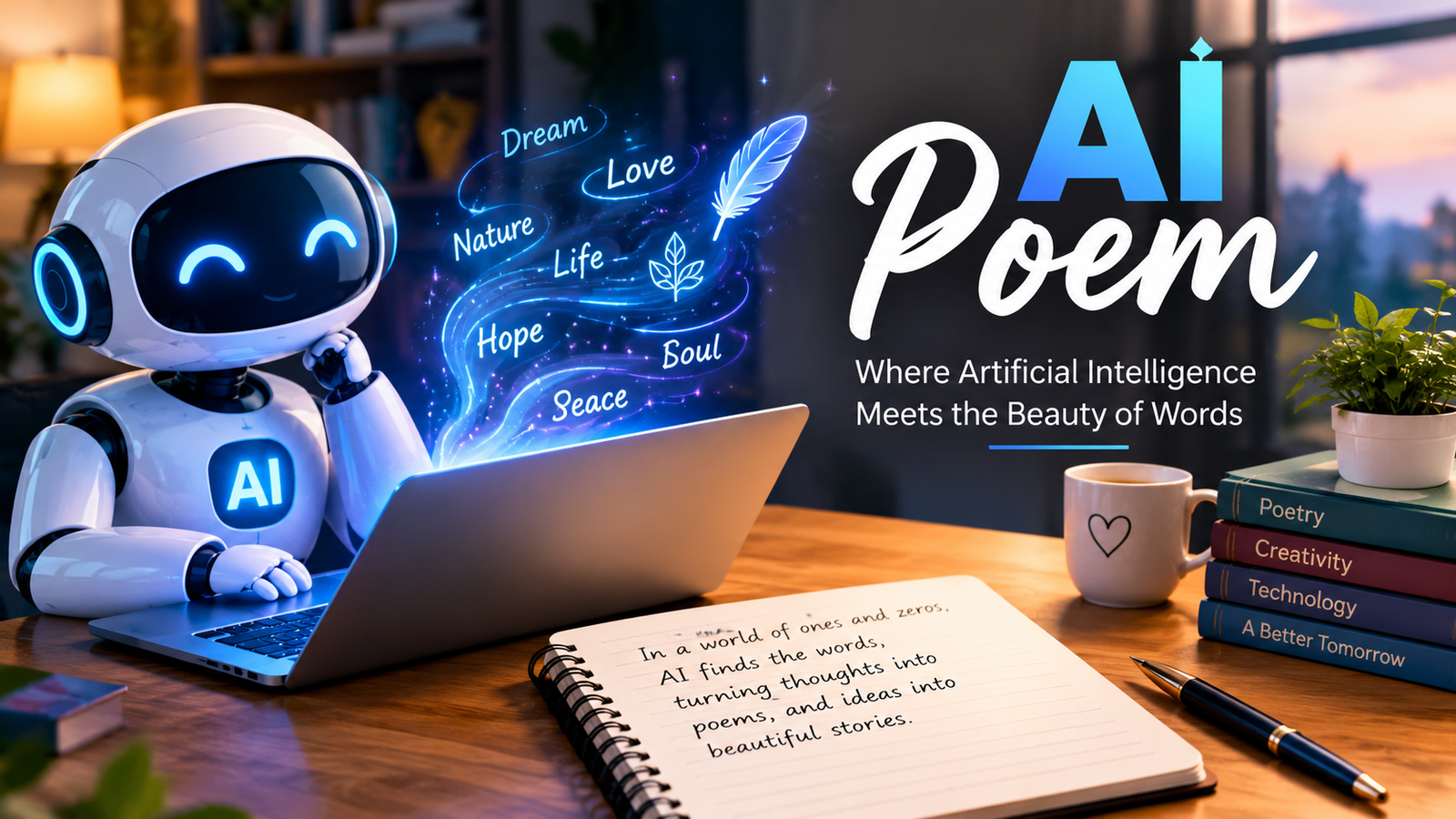
An AI poem is poetry created with the help of artificial intelligence. Instead of starting with a blank page, you can give an AI tool a topic, emotion, poetic form, tone, or a few personal details and receive a draft in seconds. You can then edit, reshape, and personalize that draft until it sounds like your own work.
AI can be useful for brainstorming, overcoming writer’s block, experimenting with different poetic forms, or creating a poem for a specific occasion. However, the strongest results usually come from treating AI as a creative assistant rather than accepting its first response without revision.
Whether you are looking for an AI poem blog, experimenting with poems written by AI, or simply wondering can AI write poems, this guide explains how the process works, how to create better prompts, and how to turn a generic draft into a more meaningful poem.
What Is an AI Poem?
An AI poem is a poem generated or assisted by an artificial intelligence system. The user provides instructions, often called a prompt, and the AI produces text based on the requested subject, style, structure, and tone.
For example, a simple prompt might ask for a poem about autumn. A more detailed prompt could request a 12-line free-verse poem about autumn, using falling leaves, cold streets, and childhood memories as imagery.
The second approach usually produces a more focused result because the AI has more creative direction.
How Does AI Generate a Poem?
The process generally looks like this:
Idea → Prompt → AI-generated draft → Review → Editing → Final poem
AI systems can recognize patterns in language and reproduce many conventional features of poetry, including rhyme, repetition, imagery, stanza structures, and different tones. However, they do not automatically know which details have personal meaning to you.
That is why human input remains valuable throughout the process.
How to Create an AI Poem
Creating poetry with AI does not require complicated instructions. A simple workflow can produce a useful first draft, while additional prompts can improve it.
1. Choose a Topic
Start with a clear subject.
You might choose:
- Love
- Friendship
- Nature
- Family
- School
- Memories
- Success
- Grief
- Travel
- A special person
Instead of simply saying “write a poem,” tell the AI exactly what the poem should be about.
2. Choose a Poetry Form
The form influences the way the poem should be structured.
For example, you might request:
- Haiku
- Sonnet
- Limerick
- Free verse
- Acrostic
- Villanelle
If you do not have a specific structure in mind, free verse is a useful starting point because it gives the AI more flexibility.
3. Define the Emotion and Tone
Tell the AI how you want the poem to feel.
Useful descriptions include:
- Romantic
- Hopeful
- Sad
- Peaceful
- Funny
- Mysterious
- Inspirational
- Nostalgic
- Reflective
“Write a poem about rain” is broad. “Write a nostalgic poem about rain reminding someone of their childhood” provides much stronger creative direction.
4. Add Specific Details
Specific details make an AI-generated poem less generic.
Instead of:
Write a poem about my best friend.
Try:
Write a warm, 12-line poem about my best friend who always waited for me after school. Include an old bicycle, summer evenings, and the feeling of growing up together.
Those details give the AI meaningful material to work with.
5. Set the Length and Structure
You can request a specific number of:
- Lines
- Stanzas
- Words
- Syllables
You can also specify a rhyme pattern or meter when appropriate.
6. Generate and Revise
Do not assume the first version is the final version. Read it carefully and identify weak lines, predictable metaphors, awkward rhymes, or phrases that do not sound natural.
Then ask the AI to revise those specific areas.
The Best AI Poem Prompt Formula
A useful prompt can follow this formula:
Topic + emotion + form + tone + imagery + length + restrictions
For example:
Write a 12-line free-verse poem about two old friends meeting again after many years. Use rain, an empty train station, and an old photograph as imagery. Make the tone nostalgic and hopeful. Avoid clichés and overly dramatic language.
This is much more precise than simply asking for an AI poem.
Weak vs. Strong Prompt
| Prompt Type | Example | Expected Result |
| Basic | Write a poem about love. | Broad and generic |
| Better | Write a romantic poem about missing someone. | More focused |
| Detailed | Write a 12-line nostalgic poem about two people reconnecting after years apart, using rain and a train station as imagery. | More specific and personal |
The goal is not to make your prompt unnecessarily long. The goal is to provide the information that actually matters to the poem.
AI Poem Examples
Different prompts can produce completely different types of poetry.
AI Love Poem
A love poem can focus on memories, relationships, distance, commitment, or small everyday moments. Instead of relying on common romantic phrases, ask for specific imagery connected to the relationship.
AI Friendship Poem
For friendship, include shared experiences such as school, travel, difficult moments, inside jokes, or years of support. These details can make the poem feel much more authentic.
AI Nature Poem
Ask the AI to concentrate on sensory details such as the sound of rain, the smell of wet soil, changing light, wind, or birdsong.
AI Birthday Poem
A birthday poem can combine celebration with personal memories. Include the person’s interests, personality, age, or an important shared experience.
AI Motivational Poem
For motivational poetry, specify the challenge and desired emotional direction. A poem about recovering from failure will be different from one about achieving a long-term goal.
Types of Poems You Can Create With AI
One advantage of AI poetry tools is their ability to experiment with different structures.
| Poem Type | Basic Structure | Suitable For |
| Haiku | 3 short lines | Nature and reflection |
| Sonnet | 14 lines | Love and serious themes |
| Limerick | 5 lines, often humorous | Comedy |
| Free verse | Flexible structure | Personal expression |
| Acrostic | Lines form a word through initial letters | Names and messages |
| Villanelle | Repeated lines and formal structure | Complex themes |
Haiku
A traditional haiku is a short three-line poem commonly associated with a 5-7-5 syllable pattern in English adaptations. If exact syllable structure matters, check the finished poem manually rather than assuming the AI counted perfectly.
Sonnet
A sonnet traditionally contains 14 lines and follows established structural and rhythmic conventions. You can ask AI to follow a particular rhyme scheme and meter, but the result should still be reviewed carefully.
Limerick
Limericks are short, rhythmic poems traditionally consisting of five lines and often following an AABBA rhyme pattern. They work particularly well for humorous subjects.
Free Verse
Free verse does not require a fixed rhyme scheme or meter. This makes it a flexible choice when you want the AI to concentrate on imagery, emotion, and natural language.
How to Make an AI Poem Sound More Human
One of the biggest problems with generic AI poetry is that it can sound predictable. The solution is not necessarily to generate a longer poem. Instead, give it better material and edit the output.
Add Personal Experiences
Replace generic statements with real memories.
Instead of asking for a poem about friendship, mention the location, event, person, or moment that makes the friendship meaningful.
Replace Generic Metaphors
AI can sometimes rely on familiar comparisons involving stars, oceans, dreams, or endless love.
Ask it to use less predictable imagery.
Use Sensory Details
Describe what someone could actually see, hear, smell, taste, or touch.
For example:
The kitchen light stayed on
while rain tapped against the window.
Specific details often feel more personal than abstract declarations.
Remove Clichés
Ask the AI:
Rewrite this poem and remove predictable romantic phrases. Replace them with specific, original imagery while preserving the meaning.
Read It Aloud
Poetry is meant to be heard as well as read. Reading an AI-generated poem aloud can reveal awkward rhythm, forced rhymes, repetitive wording, and unnatural sentence breaks.
AI Poem Generator vs. General AI Chatbot
An AI poem generator is usually designed specifically around poetry, while a general AI chatbot can provide more flexible conversational editing.
| Feature | AI Poem Generator | General AI Chatbot |
| Poetry-focused design | Usually | Not always |
| Custom prompts | Varies | Usually flexible |
| Poetry forms | Often available | Prompt-dependent |
| Revisions | Varies | Usually conversational |
| Creative brainstorming | Good | Good |
| Best use | Quick poetry creation | Detailed creative workflow |
The right choice depends on what you need. Someone who wants a quick poem may prefer a specialized generator, while a writer who wants to develop and repeatedly revise a poem may benefit from a conversational AI tool.
What Can You Use an AI Poem For?
AI poetry has practical applications beyond experimentation.
Personal Messages
You can create a starting draft for:
- Birthdays
- Anniversaries
- Thank-you messages
- Friendships
- Weddings
- Special occasions
Adding personal information makes the result much more meaningful.
School and Learning
Students can use AI poetry as a starting point for learning about rhyme, imagery, meter, and poetic forms. However, if a school assignment requires original student work or restricts AI use, follow the applicable classroom rules.
Social Media
Short poems can work as creative captions, posts, or inspirational content. Keep the language concise and edit the final version for your audience.
Creative Writing
Writers can use AI to brainstorm themes, explore alternative openings, experiment with forms, or overcome writer’s block.
Image-to-Poem Projects
You can also use an image as inspiration. Describe what is visible, explain the mood you want, and specify the desired poetic form. The AI can then create a poem based on those elements.
Common Problems With AI-Generated Poems
AI poetry can be useful, but it is not perfect.
| Problem | Why It Happens | How to Improve It |
| Generic language | Vague instructions | Add specific details |
| Forced rhyme | Rhyme prioritized over meaning | Request natural wording |
| Repetition | Similar patterns are reused | Ask for alternatives |
| Wrong syllable count | AI may miscount | Check manually |
| Weak emotion | Little personal context | Add memories and experiences |
| Awkward rhythm | Language sounds unnatural | Read aloud and revise |
Understanding these limitations helps you get more useful results from an AI poetry tool.
How to Improve an AI Poem With Follow-Up Prompts
Your first prompt does not have to do everything.
Try follow-up instructions such as:
Improve imagery:
Replace generic descriptions with specific sensory imagery.
Improve rhythm:
Rewrite these lines so they sound natural when read aloud while preserving their meaning.
Remove clichés:
Remove predictable metaphors and replace them with fresh, concrete images.
Make it personal:
Keep the structure but incorporate these three personal memories into the poem.
Change the tone:
Make the poem quieter and more reflective without changing its central message.
This iterative process is often more effective than repeatedly asking for completely new poems.
Is an AI Poem Original?
The answer depends on how the poem was generated, edited, and used, as well as the applicable legal and platform rules.
Do not automatically assume that every AI-generated passage is legally protected in the same way as independently human-created writing. If you plan to publish or commercially use a poem, check the terms of the AI service and the relevant copyright rules for your jurisdiction.
Human creative contribution also matters. Writing the concept, supplying original details, selecting useful lines, substantially editing the draft, and shaping the final expression can make the finished work meaningfully different from an untouched AI output.
Tips for Creating Better AI Poetry
For stronger results, remember these practical tips:
- Start with a specific idea.
- Describe the emotion you want.
- Choose an appropriate poetic form.
- Add sensory details.
- Specify the desired length.
- Tell the AI what to avoid.
- Generate more than one version when useful.
- Compare different openings and endings.
- Edit generic language.
- Check rhyme and syllable patterns manually.
- Read the poem aloud.
- Add your own experiences and voice.
The best AI poetry is rarely about pressing a button once. It is about using the generated draft as raw material and making thoughtful creative decisions afterward.
Conclusion
An AI poem can be a useful starting point for creativity, whether you are experimenting with poetry, learning different forms, preparing a personal message, or overcoming writer’s block. The most effective approach is to give the AI clear creative direction and then actively shape the result.
Think of the process as idea → prompt → generation → revision → personalization. AI can provide words and possibilities, but your experiences, judgment, and creative choices are what can turn a basic draft into a poem that actually means something.
Frequently Asked Questions
Can AI write poems?
Yes. AI systems can generate poems in many forms and tones based on user instructions. The quality depends heavily on the prompt, the chosen structure, and how much the final draft is edited.
What is an AI poem?
An AI poem is poetry created entirely or partially with an artificial intelligence tool. A user can provide a topic, emotion, style, structure, and other instructions to guide the generated text.
How do I create an AI poem?
Choose a topic, select a poetic form, describe the emotion and tone, add specific imagery, set the desired length, and generate a draft. Then review and edit the result.
What is a good prompt for an AI poem?
A good prompt provides clear information about the topic, emotion, poetic form, tone, imagery, length, and any restrictions. Specific prompts generally give you more control than vague requests.
Can AI create different types of poetry?
Yes. Depending on the tool, you can request forms such as haiku, sonnets, limericks, free verse, acrostics, and other structures. Formal poetry should be checked manually for rhyme, meter, and syllable requirements.
How can I make an AI poem sound more human?
Add personal memories, specific sensory details, unusual imagery, and your own word choices. Remove clichés and generic expressions, then read the poem aloud and rewrite lines that do not sound natural.
Is an AI-generated poem original?
AI output should not automatically be treated as equivalent to independently human-created work. Before publishing or commercial use, review the AI service’s terms and the copyright rules that apply to your situation.
You May Also Read: Ella Langley
