


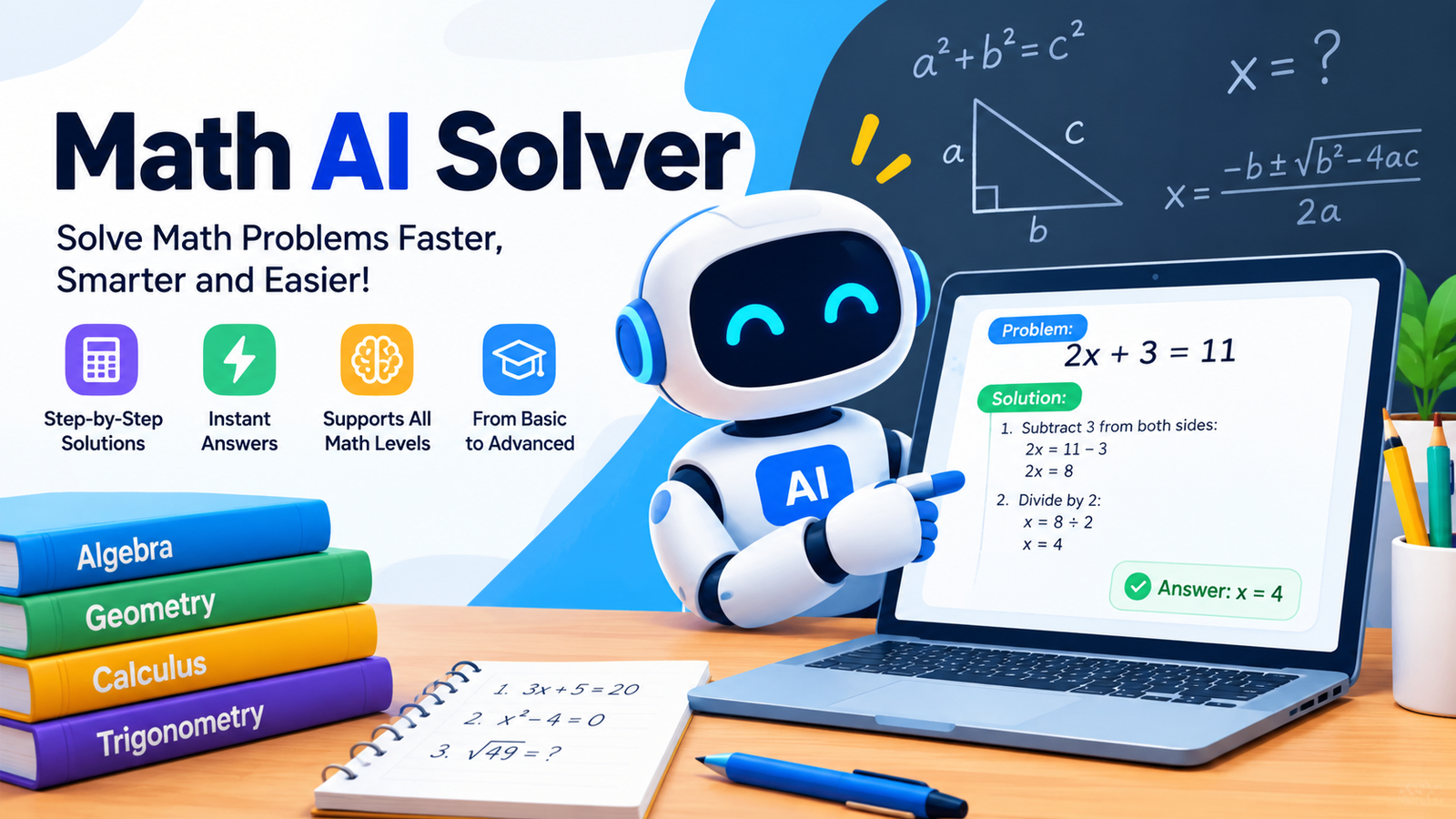
Math can become difficult when a problem involves several steps, unfamiliar formulas, or complicated calculations. A math AI solver can make that process easier by analyzing a problem, working through the calculations, and explaining how the answer was reached. Instead of giving only a final number, modern AI tools can often break a problem into understandable steps.
Whether you are working on algebra, geometry, calculus, fractions, or word problems, an AI math solver can provide quick assistance. Some tools also support image input, allowing you to upload a worksheet or equation instead of typing everything manually.
However, AI should not be treated as an unquestionable source of truth. The most useful approach is to use it to understand a solution, check your work, and practice similar problems. This guide explains how math AI tools work, what they can solve, how to use them effectively, and how to verify their answers.
What Is a Math AI Solver?
A math AI solver is an artificial intelligence tool designed to understand and solve mathematical problems. Depending on the tool, you can enter an equation, type a word problem, or upload an image of a question. The system analyzes the information and produces a solution.
Unlike a traditional calculator, an AI math solver can often understand the context of a question. For example, instead of entering a long calculation manually, you can ask it to solve an equation and explain each step.
A good solver can be useful for both quick answers and learning. Students can use it to identify mistakes, understand formulas, review homework, and practice new concepts.
What Can a Math AI Solver Do?
The exact capabilities vary between tools, but common functions include:
- Solving equations and inequalities
- Simplifying mathematical expressions
- Working with fractions and percentages
- Solving algebra problems
- Explaining geometry questions
- Handling trigonometry
- Working through calculus problems
- Helping with statistics and probability
- Solving mathematical word problems
- Checking an existing solution
- Explaining formulas and mathematical concepts
The quality of the result depends on the problem, the tool, and how clearly the question is provided.
How Does a Math AI Solver Work?
Although the technology behind AI mathematics tools can be complex, the user experience is usually straightforward.
1. Enter or Upload the Problem
First, provide the mathematical question. You may type an equation such as:
3x + 9 = 24
Some platforms also allow you to upload a picture of a worksheet or handwritten problem. This makes a math AI solver picture feature particularly useful for students working from textbooks or printed assignments.
2. The AI Recognizes the Problem
The system analyzes numbers, variables, symbols, and instructions. If you upload an image, the tool must first recognize the mathematical content before attempting to solve it.
Clear images generally produce better results. Blurry photographs, unusual handwriting, shadows, or cropped equations can cause recognition mistakes.
3. The Solver Selects a Method
The AI determines how to approach the problem. Depending on the question, it may use methods such as factoring, substitution, simplification, differentiation, integration, or statistical calculations.
4. It Generates the Solution
The solver then calculates the result and may provide intermediate steps. This is important because a final answer by itself does not necessarily help someone understand the mathematics.
5. You Check the Result
Finally, review the steps and verify the answer. For an equation, one simple method is to substitute the result back into the original problem.
This final step is especially important when using AI for complex mathematics.
What Types of Math Can AI Solve?
A modern AI math solver can cover many areas of mathematics, although capabilities differ from one tool to another.
| Math Type | Common Examples |
| Arithmetic | Addition, multiplication, percentages |
| Fractions | Simplification and operations |
| Algebra | Equations and inequalities |
| Geometry | Angles, area, volume |
| Trigonometry | Sine, cosine, identities |
| Calculus | Derivatives, limits, integrals |
| Statistics | Mean, probability, data analysis |
| Linear Algebra | Matrices and systems |
| Word Problems | Rates, distance, money, quantities |
Arithmetic and Fractions
Basic arithmetic is one of the simplest applications. AI can also help explain fractions, decimals, percentages, ratios, and proportions.
For example, instead of simply calculating 25% of 80, you can ask the tool to explain why the answer is 20.
Algebra and Equations
AI is particularly useful for equations because it can show transformations step by step.
For example:
2x + 8 = 20
Subtract 8 from both sides:
2x = 12
Divide both sides by 2:
x = 6
The explanation is more valuable for learning than simply displaying the number 6.
Geometry and Trigonometry
Some tools can help with angles, triangles, area, perimeter, volume, and trigonometric relationships. Diagram-based problems can be more challenging because the AI must correctly understand the visual information.
Calculus
Depending on the tool, AI can assist with derivatives, integrals, limits, functions, and related calculations. Advanced calculus problems should still be checked carefully because a small interpretation error can affect every subsequent step.
Statistics and Probability
AI can help explain concepts such as averages, standard deviation, probability, combinations, and data interpretation. When working with a dataset, always make sure the values entered into the tool are correct.
Word Problems
Word problems require more than calculation. The solver must understand what the question is asking and identify the relevant information.
For this reason, word problems are a good example of why you should review an AI-generated solution rather than automatically accepting it.
How to Use a Math AI Solver
Using a math AI solver online is generally simple, but the quality of your input can affect the quality of the response.
Step 1: Enter the Complete Problem
Provide the entire equation or question rather than only part of it.
Step 2: Upload a Picture When Available
If typing is inconvenient, use an image feature. A take a picture math solver online workflow can be useful for worksheets, textbook exercises, and printed equations.
Make sure the picture is:
- Clear
- Well lit
- Properly framed
- Not blurry
- Large enough to read
- Free from unnecessary background objects
Step 3: Request Step-by-Step Working
Instead of asking only for an answer, ask:
“Solve this problem step by step and explain why each step is necessary.”
This encourages a more educational response.
Step 4: Review the Method
Look at the transformations rather than jumping directly to the final answer.
Step 5: Verify the Result
Substitute the answer into the original equation or solve the problem using another method.
Step 6: Practice a Similar Question
After understanding the solution, try another problem without AI. This turns a solver into a learning tool rather than an answer-copying tool.
Example: Solving an Equation With AI
Consider this equation:
3x + 9 = 24
A solver should recognize that the goal is to isolate x.
First, subtract 9 from both sides:
3x = 15
Next, divide both sides by 3:
x = 5
The answer is therefore 5.
You can take the process further by asking the AI to generate a similar equation. For example:
4x + 8 = 28
You can then attempt it yourself before checking the solution.
A More Advanced Example
Consider:
x² – 5x + 6 = 0
The expression can be factored as:
(x – 2)(x – 3) = 0
Therefore:
x = 2 or x = 3
A useful AI interaction would not stop at these answers. Ask the solver to explain why the quadratic factors this way and then verify both values in the original equation.
Can You Solve Math From a Picture?
Yes, some AI-powered math tools support image or camera input. This allows you to capture an equation instead of typing it manually.
A typical process is:
Take photo → Upload image → Recognize equation → Solve → Review steps
This can save time when working with a full worksheet.
However, image recognition has limitations. A solver may misread a minus sign as a plus sign, mistake a variable for another character, or misunderstand a fraction if the image is unclear.
Always compare the AI’s recognized problem with the original picture before reviewing its answer.
Math AI Solver vs Calculator
A calculator and an AI solver serve different purposes.
| Feature | Traditional Calculator | Math AI Solver |
| Basic calculations | Yes | Yes |
| Complex arithmetic | Yes | Yes |
| Equation solving | Limited by model | Often supported |
| Step explanations | Usually limited | Often available |
| Word problems | No | Often supported |
| Image input | Usually unavailable | Available in some tools |
| Concept explanations | No | Often available |
| Practice questions | No | Available in some tools |
A calculator is excellent when you already know what calculation to perform. An AI solver can be more useful when you need help understanding the problem or selecting a method.
Math AI Solver vs General AI Chatbots
General AI systems can also answer mathematical questions, but dedicated math tools may provide workflows designed specifically for equations and calculations.
| Feature | Math AI Solver | General AI Chatbot |
| Math-focused interface | Usually | Not always |
| Equation solving | Core feature | Often available |
| Step-by-step explanations | Common | Common |
| General conversation | Limited | Strong |
| Image support | Tool dependent | Tool dependent |
| Advanced computation | Tool dependent | Varies |
Tools such as Math GPT AI can also be used for conversational mathematical assistance, but the exact capabilities depend on the platform. For important or advanced calculations, verify the result independently.
Are Math AI Solvers Accurate?
AI can solve many standard mathematical problems correctly, but no AI system should be assumed to be perfect.
Accuracy can be affected by:
- Incorrect input
- Poor image recognition
- Ambiguous wording
- Missing information
- Complex proofs
- Unusual mathematical notation
- Incorrect assumptions
For example, an AI might correctly perform an algebraic calculation but misunderstand a word problem because the wording is ambiguous.
How to Verify an AI Math Answer
Use this simple process:
1. Check the original problem.
Make sure the AI understood every number and symbol.
2. Review the major steps.
Look for unexplained changes or incorrect transformations.
3. Substitute the answer.
For equations, put the result back into the original equation.
4. Try another method.
When practical, solve the problem independently or use a separate calculation method.
5. Make sure you understand it.
A correct answer is not enough if you cannot explain how it was obtained.
How to Get Better Results From a Math AI Solver
Better prompts can produce more useful explanations.
Use Clear Mathematical Notation
Instead of:
“solve x thing”
write:
“Solve 2x + 7 = 19 and show every step.”
Upload a Clear Image
If using picture input, photograph only the relevant question and make sure all symbols are visible.
Ask for an Explanation
Try:
“Explain this solution in simple language suitable for a beginner.”
Ask It to Check Your Work
You can provide your attempt and say:
“Check my solution and identify the first step where I made a mistake.”
This is often more educational than requesting the final answer immediately.
Ask for Practice
After solving a question, try:
“Give me three similar problems without solutions so I can practice.”
Math AI Solver for Homework
A free math solver can be helpful for homework when it is used as a learning aid.
For example, a student can attempt a problem independently and then use AI to identify a mistake. The student can also ask for a hint, explanation, or similar practice question.
The less useful approach is to copy an answer without understanding the process. That may complete one question but does not necessarily build mathematical ability.
A productive homework workflow is:
Attempt → Ask for help → Understand → Verify → Practice
Free vs Paid Math AI Solvers
You may find a Best math AI solver free option for your particular needs, but free and paid tools often differ in available features.
| Feature | Free Options | Paid Options |
| Basic problems | Often available | Usually available |
| Step-by-step solutions | Varies | Often available |
| Image solving | Varies | More likely |
| Advanced mathematics | Varies | Often broader |
| Usage limits | May apply | Usually higher |
| Extra learning features | Varies | May be included |
Features and limits can change, so check the current details of a specific service before relying on it for an important assignment.
Benefits of Using a Math AI Solver
A math AI solver can provide several practical advantages.
Fast assistance: You can get help without manually searching through multiple explanations.
Step-by-step learning: Many tools can explain the process instead of showing only an answer.
Homework support: Students can use AI to review difficult questions.
Error checking: You can compare your own solution with an AI-generated approach.
Flexible input: Some tools accept typed questions, while others support images.
On-demand explanations: You can ask follow-up questions when a particular step is confusing.
Limitations of Math AI Solvers
AI tools are useful, but they are not a replacement for mathematical understanding.
They may misunderstand an image, make an incorrect assumption, or produce an explanation that looks convincing but contains an error.
Advanced proofs and unusual problems can require human mathematical judgment. Similarly, an AI-generated answer may not match the specific method your teacher expects.
The safest approach is to treat AI as an assistant: use it to explain, check, and practice while keeping your own reasoning involved.
Who Can Benefit From a Math AI Solver?
Students
Students can use AI for homework explanations, revision, practice, and checking calculations.
Parents
Parents can use explanations to understand how a particular problem is solved and help children review difficult concepts.
Teachers
Teachers can use AI tools for generating practice questions, checking examples, or exploring different ways to explain a mathematical concept.
College Students
AI can assist with more advanced topics such as calculus, statistics, matrices, and linear algebra, provided the results are verified.
Self-Learners
People studying mathematics independently can use AI for explanations and additional practice whenever they encounter a difficult concept.
How to Choose a Math AI Solver
Instead of choosing a tool solely because it claims to be the “best,” consider what you actually need.
| Your Main Need | Important Feature |
| Quick calculations | Fast computation |
| Learning steps | Detailed explanations |
| Worksheet problems | Image recognition |
| Advanced mathematics | Broad subject support |
| Exam preparation | Practice questions |
| Geometry | Visual or graphing support |
| Checking answers | Verification features |
For example, someone who mainly photographs textbook questions needs different features from someone studying advanced calculus.
Conclusion
A math AI solver can make mathematical problem-solving faster and more accessible. From basic arithmetic and fractions to algebra, geometry, calculus, and statistics, AI can provide useful assistance while explaining the process behind many solutions.
The most effective approach is not simply to ask AI for an answer and move on. Use it to understand the method, check your work, identify mistakes, and generate additional practice. If you use image input, make sure the original problem has been recognized correctly, and always verify important results.
When used thoughtfully, an AI math solver can become a practical study companion that helps turn difficult problems into understandable steps.
Frequently Asked Questions
What is a math AI solver?
A math AI solver is an AI-powered tool that analyzes mathematical problems and provides answers, calculations, or step-by-step explanations. Some also support image-based questions.
Is there a free math AI solver?
Yes, some services provide free math-solving features. However, available problems, usage limits, image support, and advanced features vary between platforms.
Can AI solve math problems step by step?
Yes. Many AI math tools can explain the calculations and transformations used to reach an answer. Asking specifically for step-by-step reasoning can make the response more useful for learning.
Can I solve math problems using a picture?
Some tools support image or camera input. You can photograph a printed or handwritten question and upload it for analysis. Clear images generally produce better recognition.
Can AI solve algebra equations?
Yes. AI tools can handle many algebra problems, including linear equations, quadratic equations, inequalities, and expression simplification. More complicated problems should be checked carefully.
Are AI math solvers accurate?
They can be accurate on many well-defined problems, but errors can occur. Always check the original input, review important steps, and verify the final answer when accuracy matters.
Can AI explain how it got the answer?
Yes. You can ask an AI solver to explain the method, show intermediate steps, define the formula used, or identify an error in your own work.
You May Also Read: Eric Dane
