
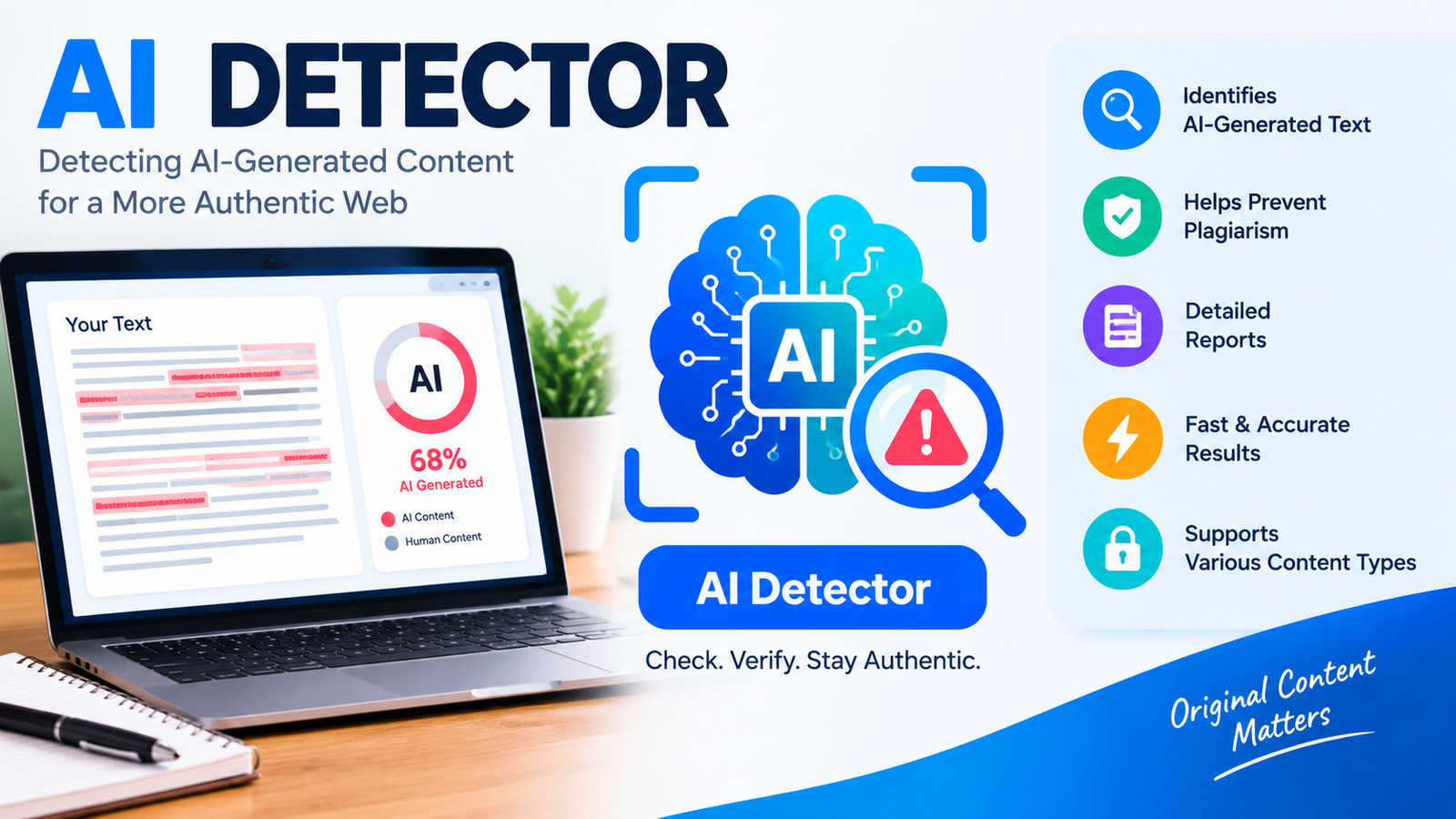
Artificial intelligence has changed how people create articles, essays, emails, product descriptions, and other types of content. As AI-generated writing becomes more common, the need to identify it has also increased. An ai detector analyzes written content and estimates whether it was produced by a person, an AI model, or a combination of both.
AI detection tools are now used by educators, publishers, businesses, marketers, and content teams. However, an AI score should not automatically be treated as proof of who wrote something. Different tools can produce different results because they use different models, training data, detection signals, and scoring methods.
This guide explains how AI detection works, what AI scores mean, how accurate these tools can be, and what to consider when choosing an AI detector.
- What Is an AI Detector?
An ai detector is software designed to analyze writing for patterns associated with AI-generated content. Instead of searching for a hidden label saying that a text was created by ChatGPT or another model, modern detectors examine linguistic and statistical characteristics within the writing.
For example, an AI detector may analyze word choices, sentence structure, phrasing, rhythm, and relationships between sentences. Winston AI explains that its detection system evaluates multiple signals rather than relying on a single word or writing habit.
The result is generally presented as a prediction or score indicating how strongly the submitted text resembles human or AI-generated writing.
Who Uses AI Detectors?
AI detection has practical applications in several areas:
- Education: Teachers can use detection as one piece of information when reviewing student submissions.
- Publishing: Editors can screen submitted articles or manuscripts.
- Marketing: Content teams can review AI-assisted drafts.
- Business: Companies can evaluate externally supplied content.
- Research: Researchers can study patterns in machine-generated writing.
- Recruitment: Organizations may use detection as an additional screening signal where appropriate.
The important point is that an AI detector should generally be treated as a screening tool, not an unquestionable authorship test.
How Does an AI Detector Work?
Modern detection systems use machine-learning models trained on examples of human and AI-generated writing. The detector looks for combinations of characteristics that distinguish the two categories.
Perplexity and Predictability
One concept associated with AI detection is perplexity, which broadly relates to how predictable the next word in a sequence is.
AI language models generate text by predicting likely tokens based on context. As a result, some AI-written passages may display highly predictable word sequences or consistently structured sentences.
However, predictable writing is not automatically AI-written. Humans can also write in a highly structured or repetitive style.
Burstiness and Sentence Variation
Another concept frequently discussed in AI detection is burstiness. It refers to variation in writing patterns, including differences in sentence length, structure, and rhythm.
Human writing can move naturally between short and long sentences. AI-generated text may sometimes appear more uniform.
Modern detectors are not necessarily limited to these two concepts. Winston AI describes systems that evaluate word and phrase choices, sentence structure, document-level variation, and contextual relationships.
Machine-Learning Classification
A modern detector can process the submitted text through a trained classification model. The model has learned patterns from datasets containing known human and AI-generated material.
The system then produces a prediction based on how closely the new sample resembles those patterns.
Some advanced systems use transformer-based architectures and embeddings to represent text before classification. Pangram, for example, describes a detection approach that tokenizes text, converts tokens into embeddings, and processes those representations through a neural network.
This is why an AI detector is much more sophisticated than simply searching for phrases commonly associated with ChatGPT.
What Does an AI Detector Score Mean?
An AI detection score is a model-generated estimate, not a direct measurement of authorship.
For example, if a detector reports that a document has a high probability of AI involvement, that does not necessarily mean the detector knows exactly who wrote it or what percentage of the document was generated by AI.
Different systems can also produce different results on the same text.
| Factor | Why It Can Affect Results |
| Text length | Longer samples provide more patterns to analyze |
| Writing style | Formal or repetitive writing can resemble generated text |
| AI model | Different models produce different linguistic patterns |
| Human editing | Editing can change the statistical characteristics |
| Mixed authorship | Human and AI passages can be difficult to classify |
| Language | Detector performance can vary between languages |
| Detector model | Different systems use different training and thresholds |
For this reason, a result should be interpreted within the context of the tool’s methodology and the content being analyzed.
How Accurate Are AI Detectors?
Accuracy is one of the most important questions surrounding AI detection. The answer depends on the detector, testing methodology, content type, language, and model being evaluated.
Some vendors publish very strong internal benchmark results. For example, Pangram reported that its 2026 Pangram 4 model achieved a 0.0041% false-positive rate on its stated benchmark and a 0.3396% false-negative rate on its challenge dataset. These are vendor-reported benchmark results, so they should be understood in the context of the company’s testing methodology rather than treated as a universal accuracy rate for every AI detector.
False Positives
A false positive occurs when human-written content is incorrectly classified as AI-generated.
This is particularly important in education, publishing, employment, and other situations where an incorrect accusation can have consequences.
Writing style can influence detection. Formal, highly structured, or relatively predictable text may sometimes resemble machine-generated writing.
False Negatives
A false negative occurs when AI-generated content is classified as human-written.
AI models, prompts, editing techniques, and detection systems continuously change, so detection performance can change as well.
Why Results Can Differ
Imagine the same 800-word article receives these results:
| Detector | AI Likelihood |
| Tool A | 18% |
| Tool B | 51% |
| Tool C | 79% |
That does not automatically mean one tool is broken. Each detector may use a different model, training dataset, threshold, and definition of AI-like writing.
Modern systems are also increasingly attempting to identify AI-assisted and mixed human-AI writing, rather than treating every document as simply human or AI. Pangram’s current research specifically discusses fully generated, AI-assisted, and mixed-author text as separate categories.
Can an AI Detector Detect ChatGPT, Claude, and Gemini?
Many AI detection systems are designed to identify text produced by major language models, including ChatGPT, Claude, and Gemini.
However, detection performance can vary depending on the exact model version, the prompt, text length, editing, and the detector being used.
ChatGPT Detection
ChatGPT-generated text can be analyzed by AI detection systems because generated writing can contain statistical and stylistic characteristics associated with language-model output.
That does not mean every ChatGPT passage will receive the same score.
Claude and Gemini Detection
The same principle applies to Claude and Gemini. A detector may recognize characteristics associated with their output, but model updates can change the characteristics of generated writing.
Consequently, claims such as “this detector catches every AI model” should be treated cautiously unless supported by transparent and current testing.
AI Detector vs. Plagiarism Checker
An AI detector and plagiarism checker solve different problems.
| Feature | AI Detector | Plagiarism Checker |
| Main purpose | Estimate AI-generated writing | Find matching or overlapping content |
| AI probability | Usually available | Usually unavailable |
| Source matching | Not its primary function | Core function |
| Detect copied text | Not its main purpose | Yes |
| Analyze writing patterns | Yes | Limited |
| Suitable for originality checks | Only partly | Yes |
An AI detector asks something like:
“Does this writing resemble AI-generated content?”
A plagiarism checker asks:
“Does this content match material that already exists elsewhere?”
Using both can therefore provide different types of information.
AI Detector vs. AI Humanizer
An AI detector analyzes text for characteristics associated with AI generation. An AI humanizer is designed to rewrite or modify AI-generated content so it reads more naturally.
These are fundamentally different functions.
Editing can change the output of an AI detector because the text being analyzed is no longer identical to the original AI-generated version. Modern detection research increasingly examines AI-assisted and AI-edited writing separately from fully generated content.
The important takeaway is that an AI detection score can change after substantial editing, so a single scan should not be treated as a permanent label attached to a document.
How to Use an AI Detector
Using an AI detector is usually straightforward.
Step 1: Select a Detection Tool
Consider:
- Detection methodology
- Supported languages
- Word limits
- Free and paid plans
- Privacy policies
- Reporting features
- Whether the company publishes testing information
Step 2: Add Your Content
Paste your article, essay, email, or other text into the detector. Some services also support document uploads.
Step 3: Run the Scan
The system analyzes the submitted content and produces a result.
For example, Walter Writes describes a workflow involving text submission, analysis of sentence structure and linguistic patterns, and an AI-likelihood score.
Step 4: Examine the Detailed Results
Don’t look only at the headline percentage. If the tool provides sentence-level analysis or highlighted passages, examine those sections too.
Step 5: Consider Other Evidence
For important decisions, consider drafts, revision history, citations, writing samples, and direct discussion with the author where appropriate.
Winston AI, Pangram, and Other Detection Tools
Several established services provide AI detection features.
Winston AI offers an AI prediction map and document-level scoring, allowing users to examine which portions of text contributed to the prediction.
Pangram publishes technical information about its detection models and has expanded its system to analyze AI-generated, AI-assisted, and mixed human-AI writing.
Walter Writes provides AI detection through its web product and API, including confidence scores and sentence-level analysis.
When comparing tools, focus on transparent methodology and current testing rather than choosing a detector simply because it advertises a large accuracy percentage.
How to Test an AI Detector Yourself
A practical ai detector blog free test can be more informative than relying entirely on marketing claims.
Create several samples:
- A human-written article
- An unedited ChatGPT response
- An unedited Claude response
- An unedited Gemini response
- A human-edited AI draft
- A mixed human-AI document
- A short paragraph
- A longer article
Then run the samples through multiple detectors.
| Sample | Source | Length | Result |
| A | Human | 500 words | Record result |
| B | ChatGPT | 500 words | Record result |
| C | Claude | 500 words | Record result |
| D | Gemini | 500 words | Record result |
| E | Human + AI | 500 words | Record result |
This approach provides a more realistic picture of how detection behaves across different writing conditions.
Can an AI Detector Prove Someone Used AI?
An AI detector should not automatically be treated as definitive proof of authorship.
The software analyzes the text that it receives. It does not directly observe the writing process, prompts, drafts, keystrokes, or every tool used to create the document.
That distinction matters.
If a teacher, editor, or employer receives a high AI score, the result can be considered alongside other evidence rather than being treated as the sole basis for a serious decision.
A responsible Best AI detector blog should therefore explain not only what detection technology can do, but also what it cannot establish.
Best Practices for Using AI Detection
For reliable and responsible use:
- Analyze enough text whenever possible.
- Don’t rely on one percentage alone.
- Check whether the detector supports your language.
- Read the provider’s methodology.
- Look for information about false positives.
- Compare results when the situation is important.
- Review drafts and revision history when available.
- Don’t assume a high score proves AI authorship.
- Check privacy policies before uploading confidential material.
For multilingual users, language support deserves special attention. Pangram has published multilingual testing that includes languages such as Hindi and Urdu, demonstrating why language-specific evaluation can matter.
Conclusion
An ai detector can be a useful tool for analyzing whether writing resembles AI-generated content, but understanding its limitations is just as important as understanding its technology.
Modern detectors examine multiple linguistic and statistical signals, and some systems now distinguish between fully AI-generated, AI-assisted, and mixed human-AI writing.
For the most meaningful results, don’t focus only on a single percentage. Consider the detector’s methodology, the length and type of content, the language, possible editing, and the context in which the result is being used.
Whether you’re an educator, marketer, editor, researcher, or content creator, the goal should be to use AI detection as one useful source of evidence—not an unquestionable verdict about authorship.
Frequently Asked Questions
What is an AI detector?
An AI detector is software that analyzes written content and estimates whether it resembles human-written or AI-generated text. It uses machine-learning models and linguistic signals to produce a prediction.
How does an AI detector work?
It analyzes patterns such as word choices, sentence structure, phrasing, variation, and contextual relationships. Modern systems may use machine-learning classifiers and neural-network architectures to evaluate multiple signals together.
Are AI detectors 100% accurate?
No detector should be assumed to be universally 100% accurate. Performance depends on the detector, dataset, language, AI model, text length, editing, and testing methodology.
Can an AI detector detect ChatGPT?
Many AI detectors are designed to identify characteristics of ChatGPT-generated writing, but results can vary according to the model version, content, editing, and detector used.
Why does human-written content sometimes get flagged?
Human writing can contain patterns that resemble characteristics found in AI-generated text. Formal language, predictable structures, short samples, and certain writing styles can affect detection results.
Is an AI detector the same as a plagiarism checker?
No. An AI detector estimates whether writing resembles AI-generated content, while a plagiarism checker primarily searches for matching or overlapping material from existing sources.
What is the best way to interpret an AI detection score?
Treat it as a statistical prediction rather than definitive proof. Review the score, highlighted passages, detector methodology, and other available evidence before drawing conclusions.
You May Also Read: Myles Garrett
