
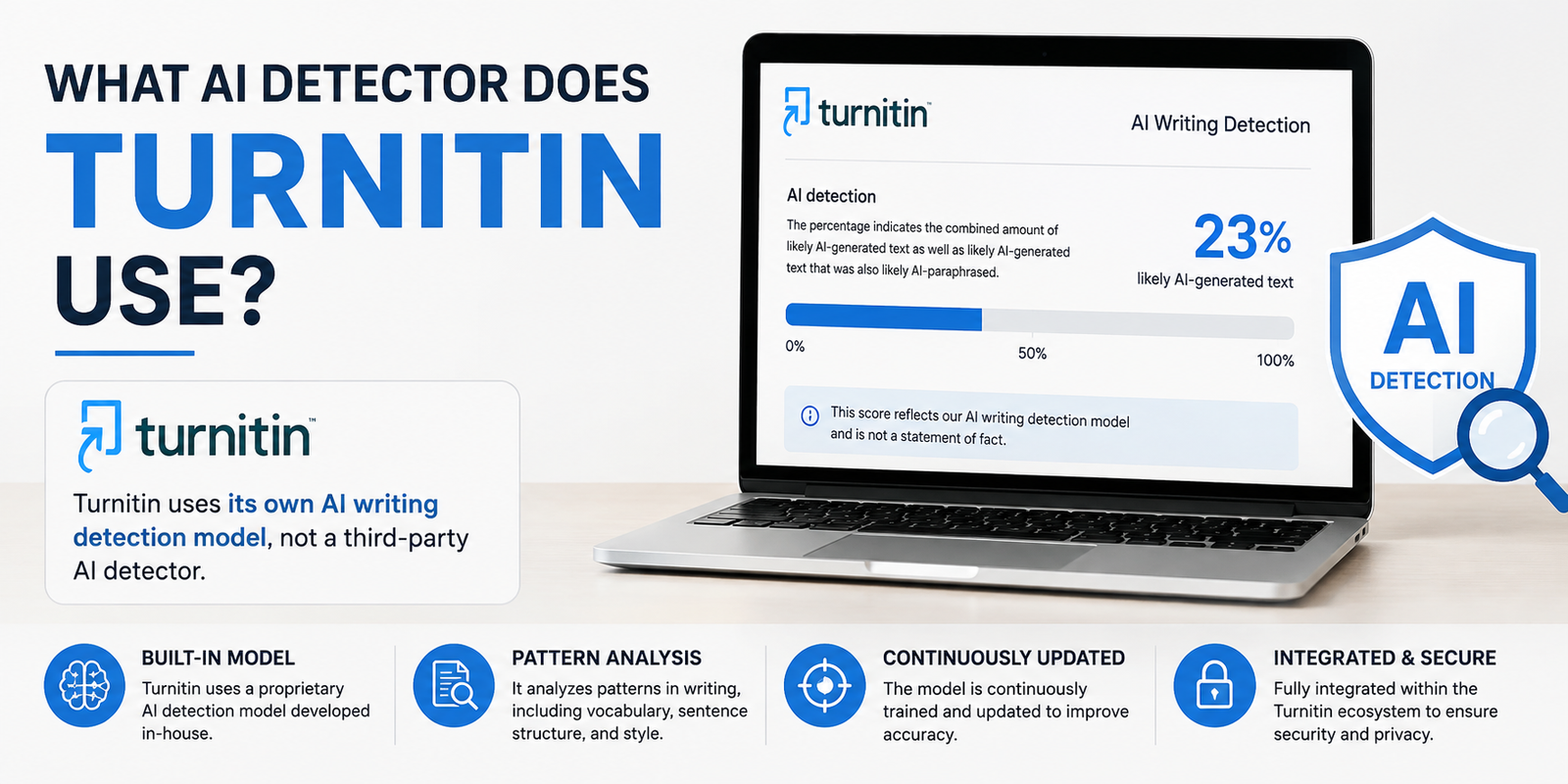
If you are wondering What AI Detector Does Turnitin Use, the short answer is that Turnitin uses its own AI writing detection technology rather than simply relying on a third-party detector such as GPTZero or Originality.ai. Its AI writing detection is integrated into Turnitin’s academic-integrity products and is designed specifically around student and academic writing.
Turnitin’s AI detection and similarity checking are also two different systems. A similarity score looks for matching text and sources, while the AI detector estimates how much qualifying prose may have been generated or modified by AI. Understanding What AI Detector Does Turnitin Use can help students and educators interpret these results more accurately.
What AI Detector Does Turnitin Use?
So, What AI Detector Does Turnitin Use? Turnitin uses its own proprietary AI writing detection model. The company describes its technology as a specialized system built for academic and student writing rather than a simple plug-in for another popular AI checker.
The technology has changed over time. Turnitin has released updates to improve detection and expand the types of AI-assisted writing it can identify. This means What AI Detector Does Turnitin Use is not necessarily answered the same way when comparing today’s technology with older Turnitin versions.
Turnitin’s AI detection system is integrated into its reporting environment. It is designed to evaluate qualifying text and provide an AI-writing prediction rather than simply searching for a specific AI tool’s signature.
Does Turnitin Use GPTZero?
If your question is What AI Detector Does Turnitin Use, it is important to understand that GPTZero is a separate service. Turnitin does not simply use GPTZero to generate its AI-writing score.
GPTZero and Turnitin use their own detection approaches. Therefore, a GPTZero result should not be considered an exact prediction of a Turnitin result. Different AI detectors can evaluate the same writing differently.
Does Turnitin Use Copyleaks or Originality.ai?
Copyleaks and Originality.ai are also independent AI detection platforms. They are not interchangeable with Turnitin’s proprietary AI writing detection technology.
This distinction is especially important for anyone researching What AI Detector Does Turnitin Use because third-party AI detectors may produce different scores for exactly the same document.
| AI Detector | Turnitin’s Own System? | Separate Service? | Results Guaranteed to Match Turnitin? |
| Turnitin AI detector | Yes | No | N/A |
| GPTZero | No | Yes | No |
| Copyleaks | No | Yes | No |
| Originality.ai | No | Yes | No |
| Walter AI detector | No | Yes | No |
How Does Turnitin AI Detection Work?
Understanding What AI Detector Does Turnitin Use is only part of the answer. It is also useful to understand how Turnitin’s AI Writing Report evaluates submitted content.
Turnitin focuses on qualifying text, particularly prose sentences in long-form writing such as essays, dissertations, and articles. Not every type of content is evaluated in exactly the same way.
A simplified process looks like this:
Document submission → qualifying prose identified → AI writing analysis → predicted AI-related text → overall AI percentage → AI Writing Report
The system is not simply looking for the word “ChatGPT.” Instead, it analyzes writing and produces a prediction about whether qualifying text appears likely to have been generated or modified by AI writing technology.
This explains why researching What AI Detector Does Turnitin Use should also involve understanding the difference between an AI-writing model and a traditional plagiarism checker.
What AI Writing Can Turnitin Detect?
Another reason the question What AI Detector Does Turnitin Use is important is that Turnitin’s capabilities have expanded beyond detecting straightforward AI-generated text.
AI-Generated Writing
Turnitin’s AI writing detection is designed to identify qualifying text that its model predicts may have been generated by a large language model.
This can include writing produced using generative AI tools such as ChatGPT and other large language models. However, the detector should not be interpreted as a perfect tool for identifying exactly which AI platform created a passage.
AI-Paraphrased Writing
Turnitin also provides AI-paraphrasing detection for English submissions. This capability is designed to identify qualifying text that was likely generated by AI and subsequently modified using an AI paraphrasing or word-spinning tool.
For someone researching What AI Detector Does Turnitin Use, this distinction matters because modern AI detection is not limited to finding untouched ChatGPT output.
AI Bypassing
Turnitin’s current documentation also discusses AI bypassing and text that may have been modified using tools designed to alter AI-generated writing.
The goal is therefore broader than simply identifying raw output from one chatbot. The system evaluates characteristics of submitted writing and produces a prediction based on its detection model.
Does Turnitin Detect ChatGPT?
Yes, and this is one of the most common follow-up questions after What AI Detector Does Turnitin Use.
Turnitin’s AI writing detection is designed to help identify writing that may have been generated by AI tools such as ChatGPT. However, detecting AI-generated writing is not the same as identifying a specific ChatGPT account or proving that a particular person used ChatGPT.
Turnitin analyzes the submitted text. It does not need access to a student’s private ChatGPT conversation to generate its AI-writing prediction.
It is also important not to assume that Turnitin can always identify whether ChatGPT, Gemini, Claude, or another specific model produced a passage. The more accurate explanation is that the system evaluates writing for characteristics associated with AI-generated or AI-modified content.
Turnitin AI Detection vs. Plagiarism Detection
If you are asking What AI Detector Does Turnitin Use, you may also be wondering whether its AI detector is the same thing as its plagiarism checker. It is not.
The AI detector estimates whether qualifying text may have been generated or modified by AI. The Similarity Report identifies matching or similar text in comparison with available sources.
These two systems answer different questions.
| Feature | Turnitin AI Detection | Turnitin Similarity Detection |
| Main purpose | Identify likely AI-generated or AI-modified writing | Identify matching or similar text |
| Main output | AI percentage | Similarity percentage |
| Looks for source matches | No | Yes |
| Uses AI-writing analysis | Yes | No |
| Same measurement? | No | No |
For example, a paper could have a low similarity score but a higher AI-writing score. Another paper could contain matching source material while showing little AI-related signal.
That is why What AI Detector Does Turnitin Use should not be confused with “What plagiarism database does Turnitin use?”
What Does a Turnitin AI Percentage Mean?
Another important part of What AI Detector Does Turnitin Use is understanding what the resulting percentage actually means.
The AI percentage represents the portion of qualifying text that Turnitin’s model predicts may have been generated by AI or, in supported cases, generated and subsequently modified with AI.
It does not mean that a student is “X% guilty,” and it does not prove that a specific percentage of the entire document was written by AI.
For example, imagine an essay receives a 30% AI result. A reasonable interpretation is that Turnitin identified approximately 30% of qualifying text as potentially belonging to its AI-detection categories.
It would be incorrect to interpret the result as proof that the student cheated 30% of the time.
Why Does Turnitin Give Different Results From Other AI Detectors?
The question What AI Detector Does Turnitin Use often comes from users who have checked the same document with multiple platforms and received different results.
This is normal. Different AI detectors can use different models, training data, thresholds, text-processing techniques, and scoring systems.
For example:
| Tool | Hypothetical AI Result |
| Turnitin | 24% |
| GPTZero | 41% |
| Another AI detector | 13% |
These differences do not automatically mean that one detector is broken. Each platform makes its own prediction using its own technology.
Therefore, a third-party “Turnitin AI detection free” tool should not be described as an exact copy of Turnitin unless there is credible evidence supporting that claim.
How Accurate Is Turnitin AI Detection?
When evaluating What AI Detector Does Turnitin Use, accuracy is an important consideration. However, it is misleading to reduce AI detection accuracy to one universal percentage.
Turnitin acknowledges that its AI detection model is not perfect. It can incorrectly identify human-written text as AI-generated and can also fail to identify some AI-generated content.
This is why an AI score should be interpreted alongside other evidence rather than treated as automatic proof of academic misconduct.
Can Turnitin Flag Human Writing as AI?
Yes. False positives are possible with AI detection.
That does not mean the technology has no value. It means that the result requires context and human review.
For example, an instructor might consider a student’s previous drafts, research notes, writing history, citations, revision process, and classroom work when evaluating a questionable submission.
This is particularly relevant for people searching What AI Detector Does Turnitin Use because they may assume an AI percentage is a definitive judgment when it is actually a model prediction.
Has Turnitin’s AI Detector Changed Over Time?
Yes. Turnitin’s AI detection technology has evolved since its introduction.
Its published model history includes changes to detection capabilities, AI-paraphrase detection, language support, and the AI Writing Report.
Turnitin has also continued to update its AI writing detection model. This means What AI Detector Does Turnitin Use can have a different practical answer depending on which version or period of Turnitin someone is discussing.
For this reason, older articles about Turnitin’s AI detector should be treated carefully. Information about an earlier model may not accurately describe the current system.
Can Students Access Turnitin AI Detection?
If you are researching What AI Detector Does Turnitin Use as a student, another practical question is whether you can access the detector yourself.
Access generally depends on how a school, college, university, or other organization licenses and configures Turnitin.
Turnitin is primarily an institutional academic-integrity platform rather than a typical consumer AI detector. Students may encounter the AI Writing Report through their institution’s submission workflow, but access and visibility can vary.
This is why searching for a Turnitin AI checker for students does not necessarily lead to a standalone consumer subscription that works exactly like other AI detection services.
Can You Predict Your Turnitin AI Score Before Submitting?
There is no reliable way to guarantee what score Turnitin will assign to a document simply by checking it with another AI detector.
Understanding What AI Detector Does Turnitin Use helps explain why. Third-party detectors use different systems, so their results may not match Turnitin.
Students can use other AI detectors for general information, but they should not assume that a result from GPTZero, Copyleaks, Originality.ai, Walter, or another service will be identical to the result generated by Turnitin.
A better approach is to follow your institution’s AI-use policy and maintain drafts, notes, research materials, and revision history when appropriate.
Turnitin vs. Other Popular AI Detectors
For anyone comparing What AI Detector Does Turnitin Use with other platforms, the following table summarizes the key difference:
| Tool | Main Audience | AI Detection | Similarity/Plagiarism | Same as Turnitin? |
| Turnitin | Education | Yes | Yes | — |
| GPTZero | Education/general users | Yes | Different | No |
| Copyleaks | Education/business | Yes | Yes | No |
| Originality.ai | Publishers/business | Yes | Yes | No |
| Walter AI detector | General users | Yes | Varies | No |
The key point is that another AI detector can provide a second opinion, but it cannot automatically reproduce Turnitin’s proprietary scoring.
What Should You Do If Turnitin Reports AI Writing?
If Turnitin reports potential AI writing, don’t assume that the percentage alone settles the issue.
If you are a student and believe your work is original, keep evidence of your writing process. Drafts, outlines, research notes, source lists, revision history, and earlier versions can help demonstrate how the work was created.
If you are an instructor, review the highlighted text and consider the broader context rather than treating the AI percentage as conclusive evidence.
Understanding What AI Detector Does Turnitin Use should ultimately help people interpret the technology responsibly rather than search for a guaranteed way to manipulate its results.
Most importantly, follow the academic-integrity and AI-use policies of the relevant institution.
Conclusion
So, What AI Detector Does Turnitin Use? Turnitin uses its own proprietary AI writing detection technology rather than simply relying on GPTZero, Copyleaks, Originality.ai, or another consumer AI detector.
Its system is designed to evaluate qualifying academic prose and can identify text that it predicts may have been generated or modified by AI. However, Turnitin also makes clear that AI detection is not perfect and should not be treated as automatic proof of academic misconduct.
For students and educators, the most useful way to understand What AI Detector Does Turnitin Use is to remember three things: Turnitin has its own detection system, AI detection is different from similarity checking, and an AI score should always be interpreted in context.
Frequently Asked Questions
What AI Detector Does Turnitin Use?
Turnitin uses its own proprietary AI writing detection technology. It is designed for academic writing and integrated into Turnitin’s reporting environment rather than simply relying on GPTZero or another consumer AI detector.
Does Turnitin Use GPTZero?
No. GPTZero is a separate AI detection service. Turnitin has its own AI writing detection model, so GPTZero’s results should not be treated as an exact prediction of a Turnitin score.
Does Turnitin Detect ChatGPT?
Yes. Turnitin’s AI writing detection is designed to help identify writing that may have been generated by AI tools such as ChatGPT. However, an AI result does not automatically prove which specific AI tool produced the text or prove academic misconduct.
Is Turnitin AI Detection Accurate?
Turnitin’s AI detector can be useful, but it is not perfect. False positives and false negatives can occur. The result should therefore be considered alongside human judgment and other evidence.
What Does a 20% AI Score on Turnitin Mean?
It means Turnitin’s model identified approximately 20% of qualifying text as potentially AI-generated or AI-modified according to its detection categories. It does not mean that 20% of the student cheated or that 20% of the entire document was proven to be AI-written.
Is the Turnitin AI Score the Same as the Plagiarism Score?
No. The AI percentage and Similarity score are separate measurements. Similarity checking looks for matching or similar text, while AI detection estimates whether qualifying prose may have been generated or modified by AI.
Can Turnitin Detect AI-Paraphrased Text?
For supported English submissions, Turnitin’s AI writing detection includes a category for qualifying text that was likely AI-generated and then modified using AI paraphrasing or word-spinning technology.
You May Also Read: Best AI Humanizer
