

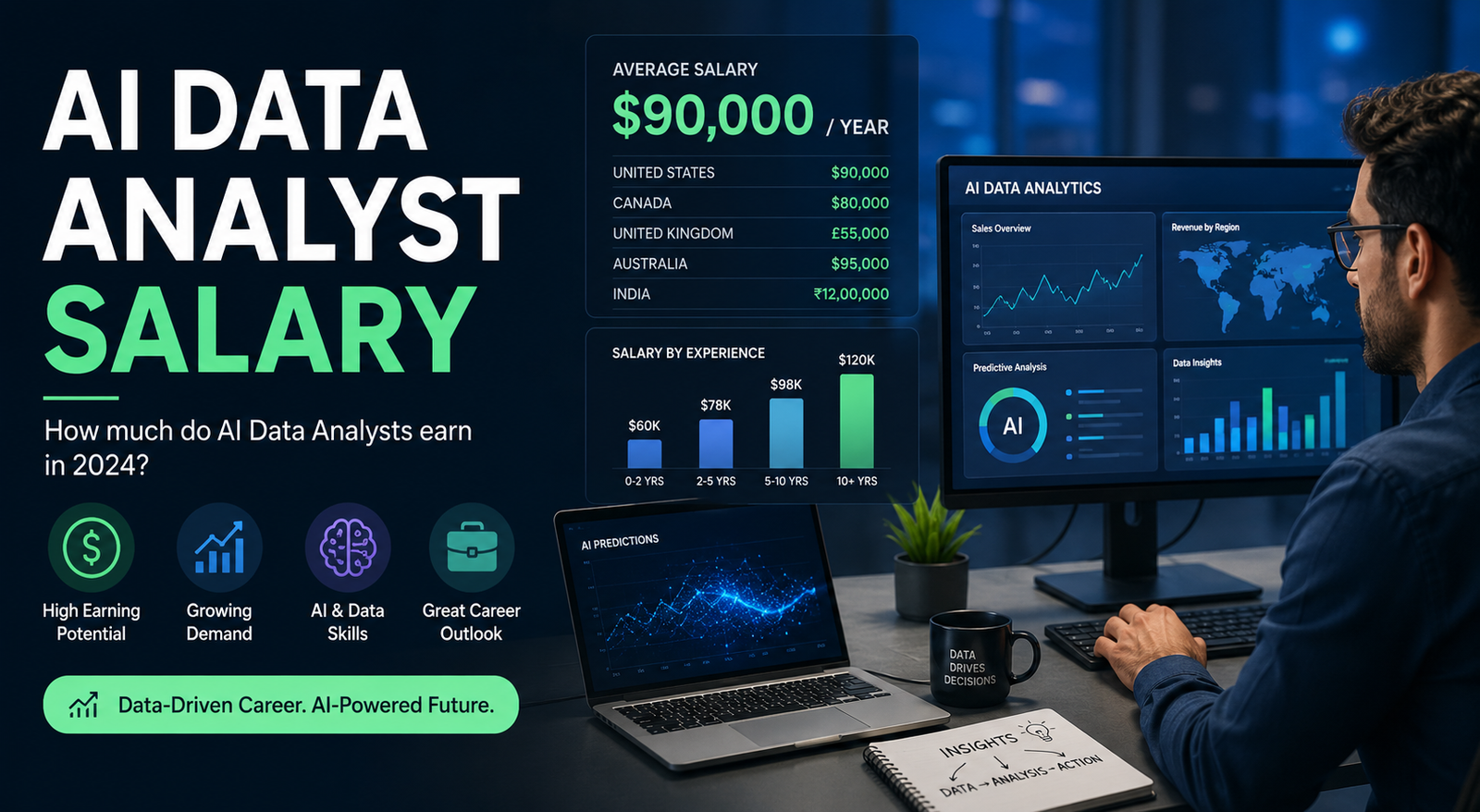
If you are considering a career in data analytics, one question is probably at the top of your list: how much does an AI Data Analyst make?
The answer depends on several factors, including experience, location, industry, technical skills, education, and the type of AI work involved. There is also an important distinction between a traditional Data Analyst who uses AI tools and an AI Data Analyst whose responsibilities include advanced automation, predictive analytics, machine learning, or generative AI workflows.
There is no single official salary category for the exact title “AI Data Analyst.” Compensation data is therefore best understood by comparing related analytics and technology occupations and then considering the additional skills expected in AI-focused roles.
In 2026, the strongest candidates are not simply good at spreadsheets and dashboards. They can combine SQL, Python, data visualization, statistics, automation, and AI tools to turn raw data into useful business decisions.
How Much Does an AI Data Analyst Make?
AI Data Analyst salaries can vary considerably. Entry-level professionals generally earn less than experienced analysts who can independently manage complex datasets, automate reporting, build predictive models, and communicate business recommendations.
For a realistic salary assessment, look at the complete compensation picture rather than one headline number. Base salary, bonuses, equity, location, industry, and seniority can all change the value of an offer.
For example, U.S. salary data for closely related occupations shows substantial differences. The Bureau of Labor Statistics reported a May 2025 median annual wage of $88,940 for operations research analysts, $105,850 for computer systems analysts, and $120,230 for data scientists. These occupations overlap with different parts of AI-enabled analytics, but they are not identical to an AI Data Analyst role.
| Career Level | Typical Responsibilities | Salary Potential |
| Entry-level | Reporting, SQL, dashboards, basic analysis | Lower |
| Mid-level | Python, automation, advanced analytics | Moderate to high |
| Senior | Predictive analytics, AI workflows, strategy | High |
| Lead/Manager | Analytics strategy, leadership, AI adoption | Very high |
These should be treated as career-level benchmarks rather than guaranteed AI Data Analyst salaries. The actual amount offered depends on the employer, market, job description, and candidate.
AI Data Analyst Salary by Experience
Experience is one of the most important factors affecting compensation. However, years alone do not determine salary. The complexity of your work and the business value you create can be equally important.
Entry-Level AI Data Analyst Salary
An entry-level AI Data Analyst may work on data cleaning, SQL queries, dashboards, reporting, and basic statistical analysis. They may also use AI assistants to speed up repetitive tasks.
Employers often value strong fundamentals more than an impressive list of AI buzzwords at this stage.
A candidate who knows SQL, Excel, Power BI, basic Python, and data visualization can have a solid foundation. Adding practical AI skills can make that person more competitive, particularly when those skills improve productivity.
Mid-Level AI Data Analyst Salary
At the mid-level, analysts are expected to work more independently.
They may build automated reports, analyze customer behavior, create forecasting models, work with APIs, and use Python for larger analytical projects. They are also more likely to communicate directly with managers and business teams.
This is where AI expertise can become particularly valuable. An analyst who can automate repetitive analysis or build an AI-assisted reporting workflow may provide considerably more business value than someone performing the same tasks manually.
Senior AI Data Analyst Salary
Senior professionals typically handle more complex datasets and higher-impact decisions.
They may design analytics strategies, mentor junior analysts, evaluate AI-generated insights, build predictive models, and work closely with executives or technical teams.
Senior AI Data Analysts may also specialize in areas such as financial analytics, customer intelligence, healthcare analytics, fraud detection, or product analytics.
AI Analytics Lead or Manager
Experienced analysts can move into management or strategic roles.
At this level, compensation is influenced by leadership responsibilities as well as technical expertise. A manager may be responsible for an entire analytics function, hiring, budgets, AI adoption, data governance, and business strategy.
AI Data Analyst Salary by Location
Location can have a major impact on compensation.
Large technology and financial markets often pay more because employers compete for specialized technical talent. However, higher salaries can also come with higher housing and living costs.
In the United States, the Bureau of Labor Statistics provides wage information by state, metropolitan area, occupation, and industry. This makes location-based salary comparisons more useful than relying on one national average.
Cities with large technology, financial, healthcare, or consulting sectors can offer particularly strong opportunities for analytics professionals.
Remote AI Data Analyst Salary
Remote work has changed the way salary should be evaluated.
A remote AI Data Analyst may work for a company located in a high-paying technology market while living somewhere with a lower cost of living. However, many employers use geographic salary bands, meaning remote workers may not automatically receive the same compensation as employees in the company’s highest-paying office.
When comparing remote jobs, look at the employer’s compensation policy instead of assuming that remote automatically means higher or lower pay.
AI Data Analyst Salary in Pakistan
The AI data analyst salary in Pakistan can differ substantially depending on employer, experience, city, technical skills, and whether the position is local or international.
Traditional Data Analyst salary information is more widely available than AI-specific salary data, so candidates should be cautious about treating a general Data Analyst figure as an exact AI Data Analyst benchmark.
Local opportunities in major technology markets can differ from smaller companies, while remote international employment can create a much wider compensation range.
For anyone researching an AI Data Analyst salary blog in Pakistan, the most useful approach is to compare several current job listings and salary sources rather than relying on one reported figure.
Professionals with SQL, Python, Power BI, machine learning, cloud platforms, and strong communication skills may be better positioned for higher-value roles.
AI Data Analyst Salary in India
India has a large and rapidly developing analytics and technology employment market.
Current salary data for traditional Data Analysts shows a wide range depending on experience and employer. Salary databases also show higher compensation trajectories for senior analysts and managers.
For an AI Data Analyst salary blog in India, it is important to distinguish between a conventional Data Analyst position and a role that actually requires AI, machine learning, automation, or advanced analytics.
Candidates in major technology hubs may encounter stronger opportunities, particularly when they combine analytics with Python, machine learning, cloud technologies, and generative AI.
The important lesson is that AI skills should complement—not replace—the fundamentals of data analysis.
AI Data Analyst Salary by Industry
Industry is another major compensation variable.
Technology companies may pay a premium for analysts who can work with large datasets and AI-powered products. Financial services may reward professionals who understand risk, forecasting, fraud, and customer analytics.
Healthcare organizations can need analysts for operational and predictive applications, while e-commerce companies rely heavily on customer behavior, pricing, marketing, and recommendation analytics.
| Industry | Common AI Analytics Applications | Pay Potential |
| Technology | Product analytics, automation, AI products | High |
| Finance | Risk, fraud, forecasting | High |
| Healthcare | Predictive and operational analytics | Medium-high |
| Consulting | Client analytics and strategy | Medium-high |
| E-commerce | Customer and pricing analytics | Medium-high |
| Marketing | Segmentation and campaign analysis | Medium |
| Government | Policy and operational analytics | Variable |
The best-paying industry is not necessarily the best choice for every candidate. A role with stronger learning opportunities, better projects, and clear advancement can produce greater long-term value.
AI Data Analyst vs. Traditional Data Analyst Salary
One of the biggest misconceptions is that adding “AI” to a job title automatically creates a higher salary.
It does not.
The potential advantage comes from the skills and responsibilities behind the title.
| Skill or Responsibility | Traditional Data Analyst | AI Data Analyst |
| SQL | Essential | Essential |
| Excel | Common | Useful |
| Data visualization | Essential | Essential |
| Python | Valuable | Highly valuable |
| Automation | Moderate | Important |
| Machine learning | Sometimes optional | Often valuable |
| Generative AI | Emerging | Increasingly relevant |
| Predictive analytics | Role-dependent | More common |
| AI workflow design | Limited | More likely |
An analyst who uses AI to automate reporting, generate insights, build forecasting workflows, or support decision-making may be able to take on more sophisticated responsibilities.
That additional capability—not the job title itself—is what can improve earning potential.
Which AI Skills Can Increase an AI Data Analyst Salary?
SQL
SQL remains one of the most important skills for any data analyst.
AI tools do not eliminate the need to understand where data comes from, how tables relate, or whether a query produces a valid result.
Python
Python can help analysts automate repetitive processes, clean large datasets, conduct statistical analysis, and work with machine learning libraries.
A strong combination of SQL and Python is particularly useful for AI-focused analytics.
Machine Learning
Machine learning can help analysts move from describing what happened to predicting what may happen next.
Examples include:
- Customer churn prediction
- Sales forecasting
- Fraud detection
- Demand forecasting
- Customer segmentation
Generative AI
Generative AI can assist with SQL generation, data exploration, documentation, reporting, and natural-language interaction with datasets.
However, analysts still need to validate AI-generated results. A fast answer is not necessarily a correct answer.
Power BI and Tableau
Visualization remains essential because executives and business teams need understandable conclusions rather than raw model outputs.
An AI Data Analyst who can combine advanced analytics with clear dashboards has a valuable combination of technical and communication skills.
Cloud and Data Platforms
Knowledge of cloud databases, APIs, data pipelines, and modern data platforms can make an analyst more capable of working with production-scale data.
AI Data Analyst Salary by Education
A bachelor’s degree is common for analytical and technical roles, although the exact requirement varies by employer.
Relevant backgrounds can include:
- Computer science
- Statistics
- Mathematics
- Economics
- Business analytics
- Information systems
- Data science
A master’s degree can be useful for advanced technical or research-oriented positions, but it is not automatically required for every AI Data Analyst job.
Practical experience can be just as important. A candidate with a strong portfolio, relevant projects, and demonstrable technical skills may be more competitive than someone who has a degree but little hands-on experience.
An AI Data Analyst course can also be useful when it provides practical projects rather than simply a certificate.
AI Data Analyst Salary by Job Title
AI Data Analyst is only one possible career direction.
Related positions include:
- Data Analyst
- Business Intelligence Analyst
- Product Analyst
- Analytics Engineer
- AI Analyst
- Data Scientist
- Machine Learning Analyst
- Analytics Manager
These titles can overlap, but their responsibilities are different.
For example, a Data Scientist may spend more time building statistical and machine learning models, while an AI Data Analyst may focus more heavily on business analysis, reporting, automation, and applying AI to analytical workflows.
Understanding the job description is therefore more useful than comparing titles alone.
How to Increase Your AI Data Analyst Salary
The fastest way to increase your earning potential is usually to become more useful, not simply to collect more certificates.
1. Master SQL
Become comfortable with joins, window functions, subqueries, CTEs, optimization, and complex analytical queries.
2. Learn Python
Use Python for data cleaning, automation, visualization, and advanced analysis.
3. Add AI and Machine Learning Skills
Learn how predictive models and generative AI can solve real business problems.
4. Build an AI-Powered Portfolio
Create projects such as:
- An AI-powered sales dashboard
- A customer churn prediction model
- An automated financial report
- An LLM-powered data-query assistant
- A predictive marketing dashboard
5. Quantify Your Business Impact
Instead of saying:
“Created a sales dashboard.”
A stronger professional achievement is:
“Created an automated sales dashboard that reduced weekly reporting time and gave managers faster access to performance trends.”
The second statement demonstrates business value.
6. Improve Communication
High-level analysts do more than produce numbers. They explain what the numbers mean and what a company should do next.
How to Negotiate an AI Data Analyst Salary
Before negotiating, research compensation for your location, experience level, industry, and skill set.
Do not rely on one salary website.
Prepare evidence showing:
- Your years of experience
- Technical skills
- AI projects
- Business results
- Industry knowledge
- Leadership responsibilities
Also evaluate total compensation.
For example, one employer might offer a higher base salary but no bonus, while another could offer a lower base with a substantial performance bonus or equity.
A reasonable negotiation statement could be:
“Based on my experience with SQL, Python, AI-powered analytics, and automated reporting, I am targeting compensation in the range of X to Y.”
The exact range should come from current market research rather than a random target.
Base Salary vs. Total Compensation
Salary is only one part of an employment package.
Consider:
- Base pay
- Annual bonus
- Performance incentives
- Equity
- Sign-on bonus
- Retirement contributions
- Health benefits
- Paid leave
- Remote-work flexibility
- Professional development
A $100,000 base salary is not automatically better than a $95,000 base salary if the second offer includes substantial additional compensation and better benefits.
Is AI Data Analytics a High-Paying Career?
AI data analytics can be a strong career path, particularly for professionals who combine traditional analytics with modern AI capabilities.
The market is also becoming more competitive. Simply knowing how to ask an AI chatbot to create a chart will not make someone an advanced analyst.
The strongest candidates understand data quality, statistics, SQL, business context, automation, and AI limitations.
The long-term opportunity is therefore less about replacing analysts with AI and more about analysts who know how to use AI effectively becoming more productive and capable.
AI Data Analyst Career Path
A typical progression might look like:
Junior Data Analyst → Data Analyst → AI Data Analyst → Senior AI Data Analyst → Analytics Lead → Analytics Manager
The path is not fixed.
Some professionals move toward Data Science, while others specialize in business intelligence, product analytics, financial analytics, machine learning, or AI strategy.
Your choice of specialization can have a significant effect on future earning potential.
Conclusion
The AI Data Analyst salary can vary widely because the role sits between traditional analytics, automation, and artificial intelligence.
Experience, location, industry, education, and job responsibilities all matter. More importantly, the most valuable AI Data Analysts combine core analytical skills such as SQL and statistics with Python, automation, machine learning, generative AI, and strong business communication.
If your goal is a higher salary, focus on building measurable expertise rather than chasing the AI label alone. A strong portfolio and the ability to turn complex data into useful business decisions can be more valuable than another generic certificate.
Frequently Asked Questions
What is the average AI Data Analyst salary?
There is no single official salary figure for the exact AI Data Analyst title. Compensation varies by experience, location, industry, and responsibilities. Related U.S. occupations such as operations research analysts, computer systems analysts, and data scientists provide useful benchmarks.
How much does an entry-level AI Data Analyst make?
Entry-level compensation depends heavily on location and employer. Candidates with strong SQL, Python, visualization, and practical AI skills may qualify for more advanced opportunities than candidates with only basic reporting experience.
Do AI skills increase a Data Analyst salary?
They can, particularly when the skills enable automation, predictive analytics, machine learning, or other higher-value work. However, AI knowledge alone does not guarantee a salary premium.
Is an AI Data Analyst paid more than a Data Analyst?
Not automatically. The difference depends on job responsibilities and skill requirements. An AI-focused position may offer stronger compensation when it requires advanced programming, machine learning, automation, or AI implementation.
What skills are needed for a high AI Data Analyst salary?
Important skills include SQL, Python, statistics, data visualization, machine learning, generative AI, automation, cloud technologies, and business communication.
Can I become an AI Data Analyst without a master’s degree?
Yes. Many analytical roles focus on practical skills and experience. A bachelor’s degree is common, but strong projects, technical skills, certifications, and relevant professional experience can also help candidates qualify.
Is AI Data Analytics a good career in 2026?
It can be an attractive career for people who enjoy both data and technology. The strongest opportunity is likely to be for analysts who use AI to improve analysis while still understanding data quality, statistics, business context, and responsible decision-making.
You May Also Read: Glen Powell Net Worth
