
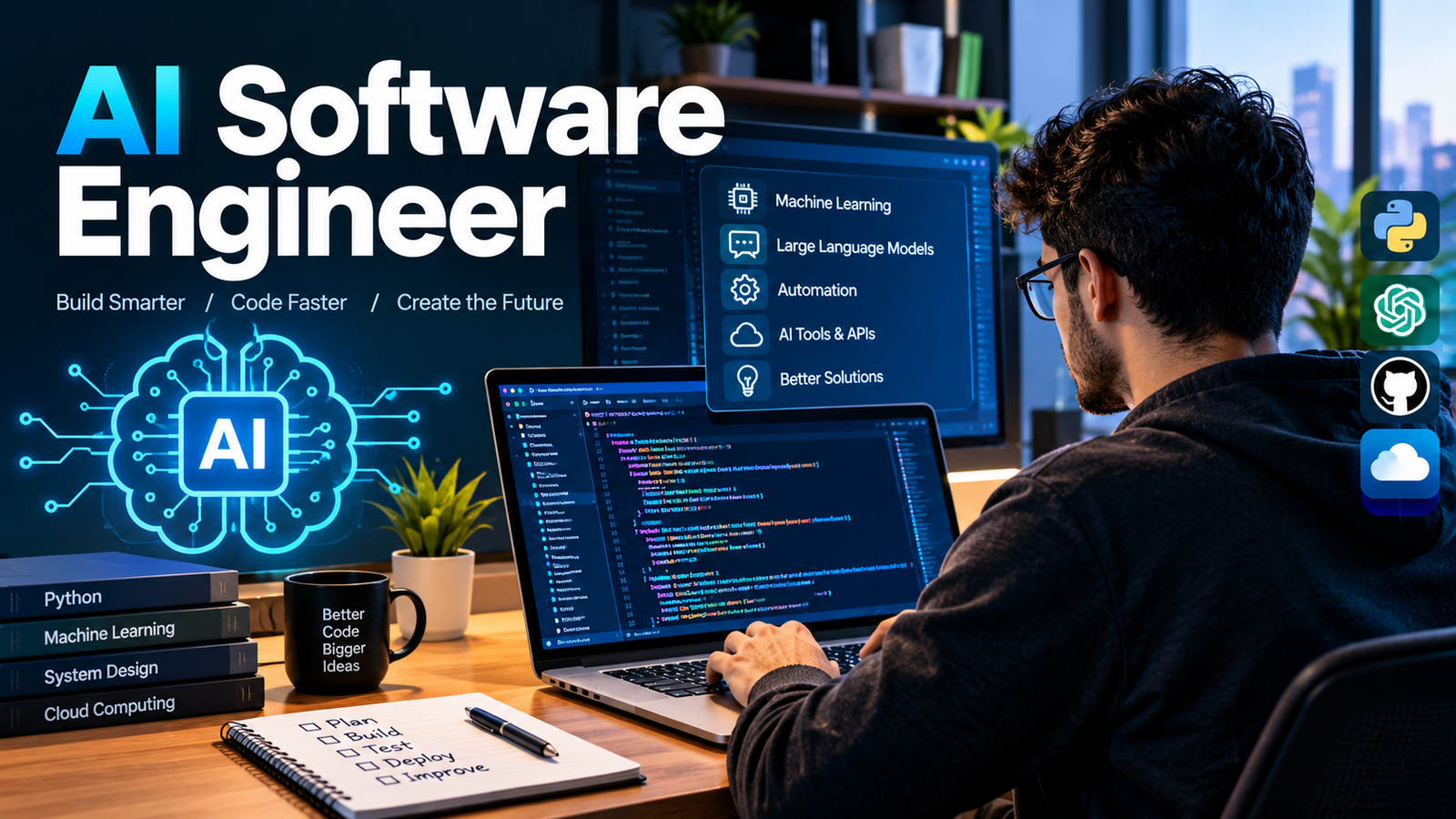
Artificial intelligence is changing how software is designed, developed, tested, and maintained. As businesses adopt large language models, machine learning, AI agents, and intelligent automation, a new type of developer is becoming increasingly important: the AI software engineer.
An AI software engineer combines traditional software development skills with artificial intelligence. Instead of only writing conventional applications, they build software that can understand language, analyze data, generate content, make predictions, automate tasks, or interact with users intelligently.
The role goes beyond prompting an AI model or using a coding assistant. A professional AI software engineer needs to understand programming, APIs, databases, system architecture, AI models, testing, deployment, security, and ongoing performance evaluation. This guide explains what the role involves, which skills matter, what tools are commonly used, and how to build a strong career or portfolio in this field.
What Is an AI Software Engineer?
An AI software engineer is a software developer who designs, builds, integrates, and maintains applications powered by artificial intelligence.
They may work with machine learning models, large language models (LLMs), computer vision systems, recommendation engines, natural language processing, or AI agents. Some engineers train models, while others primarily integrate existing models into reliable software products.
For example, an engineer could build an AI customer-support platform that receives a question, retrieves information from a company knowledge base, sends relevant context to an LLM, evaluates the response, and displays the answer through a web application.
The important distinction is that the engineer is responsible for the complete software system—not just the AI model.
What Does an AI Software Engineer Do?
The exact responsibilities vary by company and project, but several tasks are common.
Build AI-Powered Applications
AI software engineers turn AI capabilities into usable products. Examples include:
- AI chatbots
- Document analysis tools
- Recommendation systems
- AI search engines
- Coding assistants
- Content-generation platforms
- Voice applications
- Computer vision software
The engineer has to consider the user experience, application architecture, data flow, reliability, and security alongside the AI component.
Integrate AI Models and APIs
Many modern applications use existing AI models through APIs rather than training a foundation model from scratch.
An engineer may handle authentication, prompts, structured outputs, error handling, retries, response validation, and application logic. They also need to select an appropriate model based on factors such as capability, latency, cost, and task requirements.
Work With Data and Retrieval Systems
AI applications often depend on high-quality data. Engineers may build pipelines that clean, transform, store, and retrieve information.
For LLM applications, this can involve embeddings, vector databases, retrieval-augmented generation (RAG), metadata filtering, and document chunking.
Test and Evaluate AI Systems
Traditional software testing remains important, but AI applications introduce additional challenges because model outputs can vary.
Engineers may create evaluation datasets, test expected behaviors, monitor response quality, check for hallucinations, and compare model or prompt changes before releasing them.
Deploy and Monitor Applications
An AI application still needs production infrastructure.
AI software engineers may work with containers, cloud services, CI/CD pipelines, logging, monitoring, databases, authentication, and application programming interfaces. They also monitor latency, failures, usage, and costs after deployment.
AI Software Engineer vs. Software Engineer
AI software engineering builds on traditional software engineering rather than replacing it.
| Area | Software Engineer | AI Software Engineer |
| Primary focus | Software applications and systems | Software applications incorporating AI |
| Programming | Core requirement | Core requirement |
| APIs | Common | Highly relevant |
| Databases | Frequently used | Frequently used |
| Machine learning | Role-dependent | Often required |
| LLMs | Optional | Increasingly relevant |
| AI evaluation | Usually limited | Important for AI applications |
| Data pipelines | Depends on role | Often relevant |
| Deployment | Important | Important |
| MLOps | Depends on role | Useful for production AI |
A conventional software engineer may build a payment platform without using machine learning. An AI software engineer might build a fraud-detection application that combines traditional backend services with a machine learning model.
Both roles require strong engineering fundamentals. The difference is the additional AI layer and the challenges that come with it.
AI Software Engineer vs. AI Engineer vs. ML Engineer
These job titles can overlap, but their responsibilities are not always identical.
| Role | Typical Focus |
| Software Engineer | Building software systems and applications |
| AI Software Engineer | Building software products that use AI |
| AI Engineer | Applying AI technologies to business and technical problems |
| ML Engineer | Developing and deploying machine learning systems |
| Data Scientist | Analyzing data and building statistical or predictive models |
| MLOps Engineer | Infrastructure, deployment, and monitoring for ML systems |
| AI Researcher | Developing new AI methods, models, or algorithms |
Titles vary between organizations, so the actual job description is more important than the title alone.
Essential AI Software Engineer Skills
Becoming effective in this field requires a combination of software engineering, AI, and system-development skills.
Programming
Python is particularly useful for AI and machine learning because of its extensive ecosystem. JavaScript and TypeScript are also valuable for engineers building AI-powered web applications.
Depending on the organization, Java, C++, Go, or other languages may also be important.
You should understand more than syntax. Data structures, algorithms, debugging, object-oriented programming, version control, and software design remain fundamental.
Machine Learning Fundamentals
You don’t necessarily need to become a machine learning researcher, but understanding core concepts makes it easier to work with AI systems.
Useful concepts include:
- Training and inference
- Supervised and unsupervised learning
- Model evaluation
- Overfitting
- Features and datasets
- Neural networks
- Classification and regression
Generative AI and LLMs
Modern AI software development increasingly involves generative AI.
Important concepts include:
- Large language models
- Prompt engineering
- Embeddings
- RAG
- Function or tool calling
- Structured outputs
- Context management
- AI agents
- Model evaluation
Understanding how these components fit into an application is more valuable than memorizing a list of AI buzzwords.
APIs, Databases, and Backend Development
AI doesn’t exist separately from the rest of the application.
An AI engineer may need to connect models to:
- REST APIs
- Authentication systems
- SQL databases
- NoSQL databases
- Cloud storage
- External services
- Frontend applications
Strong backend knowledge therefore remains extremely useful.
Deployment and MLOps
Production AI systems need reliable infrastructure.
Useful skills include Docker, CI/CD, cloud platforms, monitoring, logging, model or prompt versioning, and performance optimization.
AI Software Engineer Technology Stack
The exact stack depends on the project, but a modern AI development environment can include:
| Category | Examples |
| Programming | Python, JavaScript, TypeScript |
| Machine learning | PyTorch, TensorFlow, scikit-learn |
| LLM platforms | OpenAI, Gemini, Claude, Hugging Face |
| AI frameworks | LangChain, LlamaIndex |
| Databases | PostgreSQL, MongoDB |
| Vector search | FAISS, Chroma, Pinecone |
| Containers | Docker |
| Cloud | AWS, Azure, Google Cloud |
| Version control | Git, GitHub |
| Testing | Unit, integration, evaluation tests |
The goal isn’t to learn every tool. A better strategy is to understand the underlying concepts and become comfortable with the tools relevant to your projects.
How AI Is Used in Software Engineering
AI can assist developers throughout the software development lifecycle.
AI-Assisted Coding
Coding assistants can help generate boilerplate, explain unfamiliar code, suggest implementations, and assist with refactoring.
However, generated code should still be reviewed and tested by an engineer.
AI Code Review
AI can identify potential bugs, inconsistencies, security concerns, and maintainability issues. Human review remains important for understanding whether a suggested change actually fits the application’s architecture.
AI Testing
AI tools can help generate test cases, analyze failures, and identify areas that require additional testing.
For AI applications themselves, engineers also need tests that evaluate model behavior and output quality.
AI Documentation
Developers can use AI to summarize code, generate documentation drafts, explain APIs, and convert technical information into more accessible explanations.
AI Coding Agents
The next stage goes beyond simple autocomplete. AI agents can perform multi-step development tasks, interact with development tools, inspect repositories, and propose or implement changes.
This makes engineering judgment even more important because developers need to define requirements, review changes, test results, and maintain system quality.
How to Become an AI Software Engineer
You don’t need to learn everything at once. A structured progression is more practical.
Step 1: Learn Programming
Start with Python or another suitable language. Learn variables, functions, classes, data structures, algorithms, error handling, and debugging.
Step 2: Learn Software Engineering
Move into Git, APIs, databases, testing, backend development, authentication, and basic system design.
Step 3: Learn AI and Machine Learning
Study fundamental machine learning concepts before moving deeply into generative AI.
Step 4: Learn LLM Application Development
Practice using model APIs, prompts, embeddings, RAG, structured outputs, and tool calling.
Step 5: Build Real Applications
Don’t rely entirely on tutorials. Build applications that solve actual problems.
Step 6: Learn Deployment
Deploy your applications using cloud platforms or other production environments. Learn Docker, monitoring, logging, and basic CI/CD.
Step 7: Build an AI Engineer Portfolio
Your portfolio should demonstrate what you can actually build.
A GitHub profile can be useful for showing source code, documentation, architecture decisions, and development history. A strong AI software engineer blog can also explain how you solved technical problems and document lessons learned from your projects.
AI Software Engineer Portfolio Project Ideas
A good portfolio should demonstrate engineering ability rather than simply showing that you can call an AI API.
RAG Document Assistant
Build an application that lets users upload documents and ask questions about their contents.
Skills demonstrated: document processing, embeddings, vector search, RAG, LLM integration, and evaluation.
AI Customer Support Agent
Create an assistant that answers customer questions using a controlled knowledge base.
Skills demonstrated: APIs, retrieval, conversation management, tool calling, and backend development.
AI Code Review Assistant
Build a tool that analyzes pull requests and identifies potential issues.
Skills demonstrated: GitHub integration, code analysis, LLMs, structured outputs, and automation.
AI Recommendation System
Create a system that recommends products, articles, courses, or other content based on user behavior.
Skills demonstrated: data processing, machine learning, APIs, and application development.
For portfolio visibility, developers can publish projects on GitHub, include setup instructions, document technical decisions, and provide screenshots or live demos where possible.
Common Challenges in AI Software Engineering
AI development introduces challenges that conventional applications may not have.
Hallucinations and Incorrect Outputs
An AI model can produce convincing but incorrect information. Applications therefore need appropriate validation, retrieval, evaluation, or human review.
Cost and Latency
Model calls can introduce additional cost and response time. Engineers may need to choose smaller models, cache results, reduce unnecessary requests, or optimize prompts and retrieval.
Security and Privacy
AI applications may process sensitive information. Engineers must consider access control, data handling, prompt injection, authentication, and secure integration with external services.
Evaluation
A conventional application might return the same output for identical input. AI systems can behave differently, making systematic evaluation particularly important.
Best Practices for AI Software Engineers
Strong AI engineering combines experimentation with disciplined software development.
- Write maintainable code.
- Test AI-generated code before deployment.
- Create evaluation datasets for important AI workflows.
- Monitor production behavior.
- Track application and model costs.
- Protect sensitive data.
- Version important prompts and application changes.
- Add fallbacks for critical workflows.
- Document limitations.
- Keep humans involved in high-impact decisions.
The most useful AI engineer isn’t simply the person who can produce the fastest prototype. It’s the engineer who can turn an AI idea into a reliable, secure, maintainable product.
Conclusion
An AI software engineer sits at the intersection of software development and artificial intelligence. The role requires more than knowing how to write prompts or call an AI model. Successful AI applications depend on programming, system design, APIs, data, evaluation, security, deployment, and ongoing maintenance.
If you’re entering the field, focus on fundamentals first. Learn to build conventional software, understand AI concepts, experiment with LLM applications, and then develop increasingly sophisticated projects. A well-documented GitHub portfolio, practical projects, and a habit of explaining your engineering decisions can help demonstrate real capability.
The field is evolving quickly, but the underlying principle remains consistent: build AI systems that solve real problems and work reliably in the real world.
Frequently Asked Questions
What is an AI software engineer?
An AI software engineer develops software applications that use artificial intelligence. Their work can involve AI APIs, machine learning, LLMs, RAG, AI agents, data pipelines, testing, deployment, and monitoring.
What programming language is best for an AI software engineer?
Python is widely useful because of its AI and machine learning ecosystem. JavaScript or TypeScript is also valuable for building AI-powered web applications. The best language depends on the type of product and existing technology stack.
Do AI software engineers need machine learning skills?
A working knowledge of machine learning is valuable, but not every AI software engineer needs to specialize in model research or training. Many focus on integrating and deploying existing models in production applications.
Is an AI software engineer the same as an ML engineer?
No. The roles can overlap, but an ML engineer often focuses more heavily on machine learning pipelines, model training, deployment, and infrastructure. An AI software engineer may focus more broadly on building complete software products that incorporate AI.
How do I become an AI software engineer?
Start with programming and software engineering fundamentals, then learn machine learning and generative AI. Build practical AI applications, learn deployment and testing, and create a portfolio that demonstrates your engineering skills.
What should an AI engineer portfolio include?
A strong portfolio can include RAG applications, AI agents, recommendation systems, document-processing tools, or AI-powered SaaS projects. Each project should explain the problem, architecture, technologies, implementation, and limitations.
Can AI software engineers use AI coding tools?
Yes. AI coding assistants and agents can support code generation, debugging, testing, documentation, and other development tasks. Engineers should still review generated code, test changes, and make architectural decisions themselves.
You May Also Read: Tom Cruise age
