
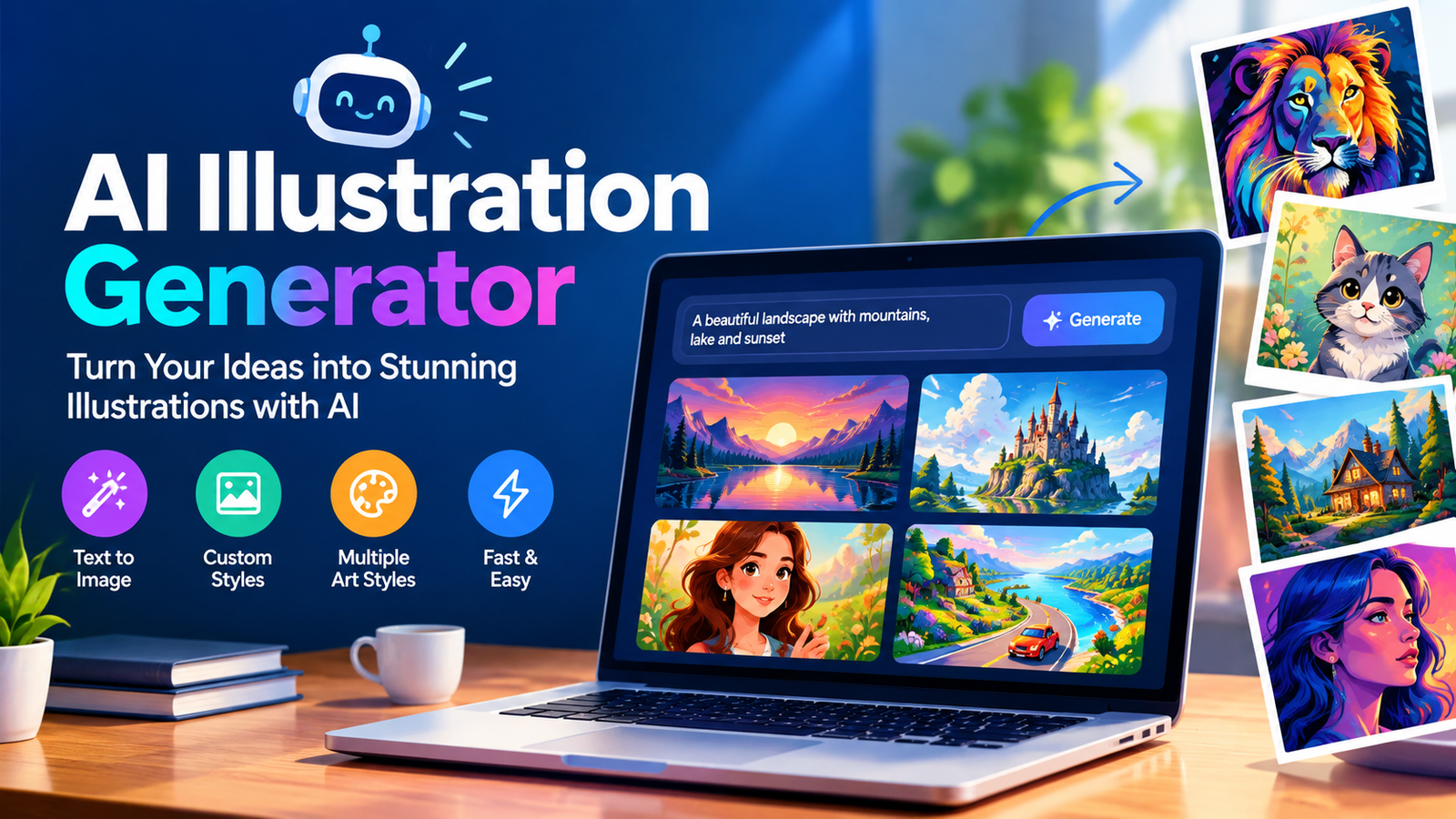
An AI illustration generator makes it easier to turn creative ideas into polished visuals without starting every project from a blank canvas. Designers, bloggers, marketers, authors, educators, and social media creators can describe an idea and quickly explore different artistic directions.
The technology is especially useful when you need several concepts, consistent visual themes, or illustrations for a project with a tight deadline. Instead of replacing the creative process, it can help with brainstorming, composition, style exploration, and early drafts.
In this guide, you’ll learn how an AI illustration generator works, what features matter, how to create better results, which illustration styles are possible, and how to use generated artwork responsibly.
What Is an AI Illustration Generator?
An AI illustration generator is a creative tool that uses generative artificial intelligence to produce artwork from instructions. The most common workflow starts with a text prompt, but many platforms also accept reference images, sketches, or existing artwork.
When choosing an AI Illustration Generator, remember that the quality of the result depends on the model, the prompt, the reference material, and the editing controls available. A detailed description gives an AI Illustration Generator more useful direction than a vague request such as “make a nice illustration.”
How It Works
Most systems interpret a written prompt and convert it into a visual composition. You can describe a subject, artistic style, color palette, background, lighting, perspective, and aspect ratio.
For example, a prompt could describe a friendly robot helping a designer in a modern office, using a clean flat style and a blue-purple palette. The generator can then create several variations for you to review and refine.
Why Use an AI Illustration Generator?
An AI Illustration Generator can reduce repetitive design work while giving creators more visual directions to explore.
The biggest advantage of an AI Illustration Generator is speed. For teams producing repeated graphics, an AI Illustration Generator can also make early concept development easier.
It is also useful for creative experimentation. You can test watercolor, cartoon, editorial, minimalist, isometric, or hand-drawn directions before deciding which visual language fits your project.
Another benefit is accessibility. Someone without advanced drawing skills can create a useful starting point for a blog graphic, presentation, story scene, classroom resource, or marketing concept.
However, generated artwork still needs human review. Small details, text, hands, objects, anatomy, and visual consistency can require additional editing.
Features to Look For in an AI Illustration Generator
Before choosing a tool, consider the capabilities that matter most to your project.
Text-to-Image Generation
This is the basic feature most users expect. Look for accurate prompt interpretation and controls that let you adjust style, composition, and aspect ratio.
Reference Images
Reference-image support can be valuable when an AI Illustration Generator needs to preserve a particular character, product, color palette, or visual direction.
Editing Tools
Generative fill, background replacement, object removal, inpainting, and image expansion can save time after the first image has been created.
Style Controls
A useful platform should make it easy to move between visual approaches such as flat vector-style artwork, watercolor, 3D, cartoon, anime, editorial, or children’s book illustration.
Export Options
Check whether you can download PNG, JPG, WebP, or SVG files. If you need editable vector artwork, don’t assume that an image described as “vector style” is a genuine SVG.
Best Uses for an AI Illustration Generator
An AI Illustration Generator can support many creative workflows.
Website and Blog Graphics
Create hero artwork, blog headers, feature images, onboarding visuals, and supporting graphics. For an AI Illustration Generator used in website design, include negative space in the prompt so important text can sit beside the artwork.
Social Media Content
Creators can develop themed visual posts, announcement graphics, educational cards, and campaign concepts without producing every illustration manually.
Children’s Books
Storybook projects can benefit from AI-assisted concept development. The main challenge is maintaining character appearance, clothing, proportions, and visual style from one scene to the next.
Character Design
You can explore character concepts, costumes, poses, facial expressions, and environments. Create a strong reference image first, then use it as a visual anchor for additional scenes.
Educational Materials
Teachers and course creators can develop diagrams, simple conceptual scenes, worksheets, and visual explanations tailored to a specific lesson.
Popular Illustration Styles With an AI Illustration Generator
One of the most useful aspects of an AI Illustration Generator is the ability to experiment with different visual styles.
Flat Illustration
Flat artwork uses simplified shapes, clean lines, and limited shading. It works well for websites, SaaS products, presentations, and business content.
Watercolor
Watercolor prompts can produce softer textures and a traditional artistic feel. This style can work well for storybooks, invitations, editorial projects, and creative branding.
Isometric
Isometric illustrations are useful for technology and business concepts because they can show multiple objects or processes in a compact scene.
Cartoon
Cartoon artwork is suitable for social content, children’s materials, characters, entertainment, and educational projects.
Minimalist
Minimalist illustrations reduce visual clutter and emphasize a few important elements. They are useful for landing pages, presentations, apps, and modern editorial designs.
How to Create an Illustration With an AI Illustration Generator
Using an AI Illustration Generator effectively starts with a clear creative brief.
Step 1: Define the Subject
State exactly what should appear in the image.
Instead of writing “technology illustration,” describe the scene: “a product designer reviewing an AI dashboard on a laptop.”
Step 2: Add the Style
Specify whether you want flat, watercolor, editorial, cartoon, isometric, hand-drawn, or another visual approach.
Step 3: Describe the Composition
Tell the model where important elements should appear. For a website hero image, you might request the subject on the right and open space on the left.
Step 4: Specify Colors
Include brand colors or a simple palette. For example, ask for navy, purple, white, and subtle gradients.
Step 5: Add Lighting and Background Details
These details help establish mood and depth. You might request soft studio lighting, a minimal office, or a warm sunset background.
Step 6: Generate Variations
Don’t assume the first result is the final version. Compare several outputs and select the one with the strongest composition and prompt accuracy.
Step 7: Refine the Result
Use editing features to remove unwanted elements, correct backgrounds, adjust colors, or improve individual areas.
AI Illustration Generator Prompts That Work for Different Projects
A strong prompt usually combines several ingredients: subject, style, composition, colors, lighting, background, details, and aspect ratio.
For a website, try:
“Modern designer using an AI dashboard, clean flat editorial illustration, blue and purple palette, minimal white background, subject on the right, negative space on the left, professional SaaS aesthetic, 16:9.”
For a children’s story:
“Curious little fox exploring an enchanted forest, whimsical children’s book illustration, soft watercolor texture, warm sunlight, expressive character, colorful flowers, charming storybook atmosphere.”
For a business concept:
“Creative team collaborating around an AI workspace, polished isometric illustration, modern technology theme, blue and violet palette, clean white background, subtle shadows, wide composition.”
How to Improve Prompt Results
When an AI Illustration Generator produces an image that is close but not quite right, don’t immediately rewrite the entire prompt.
Identify the specific problem first. If the composition is wrong, change the composition instruction. If the colors are inconsistent, strengthen the palette description. If the background is too busy, explicitly request a minimal background.
It can also help to state what should not appear when the platform supports negative prompts or exclusion instructions.
For a series of images, keep the core description consistent. Changing the wording dramatically between generations can make characters and visual styles less recognizable.
Free AI Illustration Generator Options to Explore
A free AI Illustration Generator can be useful for testing a workflow before committing to a paid plan. However, “free” does not always mean unlimited.
Some services provide a limited number of credits, while others offer daily generations or a free trial. Certain plans may also limit resolution, add watermarks, or restrict commercial usage.
Before choosing a free service, check:
- Free generation limits
- Resolution
- Watermarks
- Account requirements
- Export formats
- Commercial-use terms
- Editing features
- Credit expiration
If the artwork will be used for a client, business, book, or paid campaign, read the current licensing terms instead of assuming the free plan has the same rights as a paid subscription.
SVG vs PNG When Using an AI Illustration Generator
SVG and PNG serve different purposes.
SVG is a vector format. It can be scaled without the same pixelation associated with raster images and can contain editable paths. It is useful for icons, simple illustrations, interfaces, and designs that need to be resized.
PNG is a raster format and is often convenient for detailed artwork, website graphics, transparent backgrounds, and general image use.
A key point is that an illustration can have a vector-like appearance without being an actual SVG. If you need to edit individual shapes in a vector application, verify that the tool exports genuine vector paths.
Using AI Illustrations for Commercial Projects With an AI Illustration Generator
Before using generated artwork commercially, review the provider’s current terms. Different services can apply different conditions to free plans, paid plans, and specific models.
Commercial projects may include websites, advertising, books, merchandise, client work, presentations, and social campaigns.
It is also useful to separate platform licensing from copyright questions. A service may grant certain usage rights under its terms, while copyright protection depends on the applicable laws and the nature of the work.
For important commercial projects, keep records of the tool, plan, model, generation date, prompts, and relevant license information.
Common AI Illustration Generator Problems and Practical Fixes
An AI Illustration Generator can produce impressive results, but it is not perfect.
Inconsistent Characters
Use reference images, repeat important character details, and keep prompts consistent across a series.
Incorrect Text
AI-generated typography can contain spelling errors or strange letterforms. For important headings and labels, add text separately in a design application.
Unwanted Objects
Use editing or inpainting features to remove elements rather than regenerating the entire composition.
Poor Composition
Give explicit placement instructions and specify where negative space should remain.
Messy Vector Output
If the tool provides SVG, inspect the paths before using the artwork in a professional design workflow. Automatic vectorization can sometimes create unnecessarily complex shapes.
Tips for Better AI Illustrations
For more reliable results from an AI Illustration Generator, keep your creative brief specific but organized.
Describe one clear subject rather than cramming unrelated ideas into a single prompt. Define the style before adding decorative details. Mention the intended use, such as a website hero, book page, poster, or social post.
Generate several variations and compare them for composition, consistency, and usefulness. After selecting an image, use editing tools to make final corrections.
The most important principle with an AI Illustration Generator is to keep human judgment in the workflow. Human judgment is still important for accuracy, brand alignment, accessibility, and final design quality.
Conclusion
An AI Illustration Generator can speed up concept development and help creators explore styles that would otherwise require significant manual effort. It is useful for websites, social media, storybooks, educational materials, characters, editorial graphics, and many other projects.
The best workflow is not simply to enter a short prompt and accept the first result. Define the subject, style, composition, colors, and intended use, then generate variations and refine the strongest option.
Whether you need a free starting point, a polished business illustration, or editable vector artwork, focus on the features that match your actual project. With clear prompts and careful human review, AI can become a practical part of a modern illustration workflow.
Frequently Asked Questions
What is an AI illustration generator?
An AI Illustration Generator is a generative AI tool that creates illustrated artwork from text, images, sketches, or other references. It can produce styles ranging from flat business graphics to watercolor and character art.
Can I use an AI illustration generator for free?
Many platforms provide limited free credits, trials, or daily generations. Limits vary, so check the current plan details before relying on a free workflow.
Can AI create SVG illustrations?
Some platforms support genuine SVG or vector output, while others create raster images that only look like vector artwork. Check the export options carefully.
Can I create children’s book illustrations with AI?
Yes. AI can help create characters and scenes for children’s books. Consistency is the biggest challenge, so use reference images and a stable visual description.
Can I turn a photo into an illustration?
Many AI image tools support image-to-image transformations. You can upload a photo or sketch and describe the illustration style you want to apply.
Are AI-generated illustrations safe for commercial use?
Commercial usage depends on the provider’s current terms, plan, model, and applicable law. Review licensing information before publishing or selling the artwork.
How can I get more consistent AI illustrations?
Use a consistent prompt structure, reference images, repeated character descriptions, and the same style instructions. Editing and selecting from multiple generations can further improve consistency.
You May Also Read: Justin Bieber
