
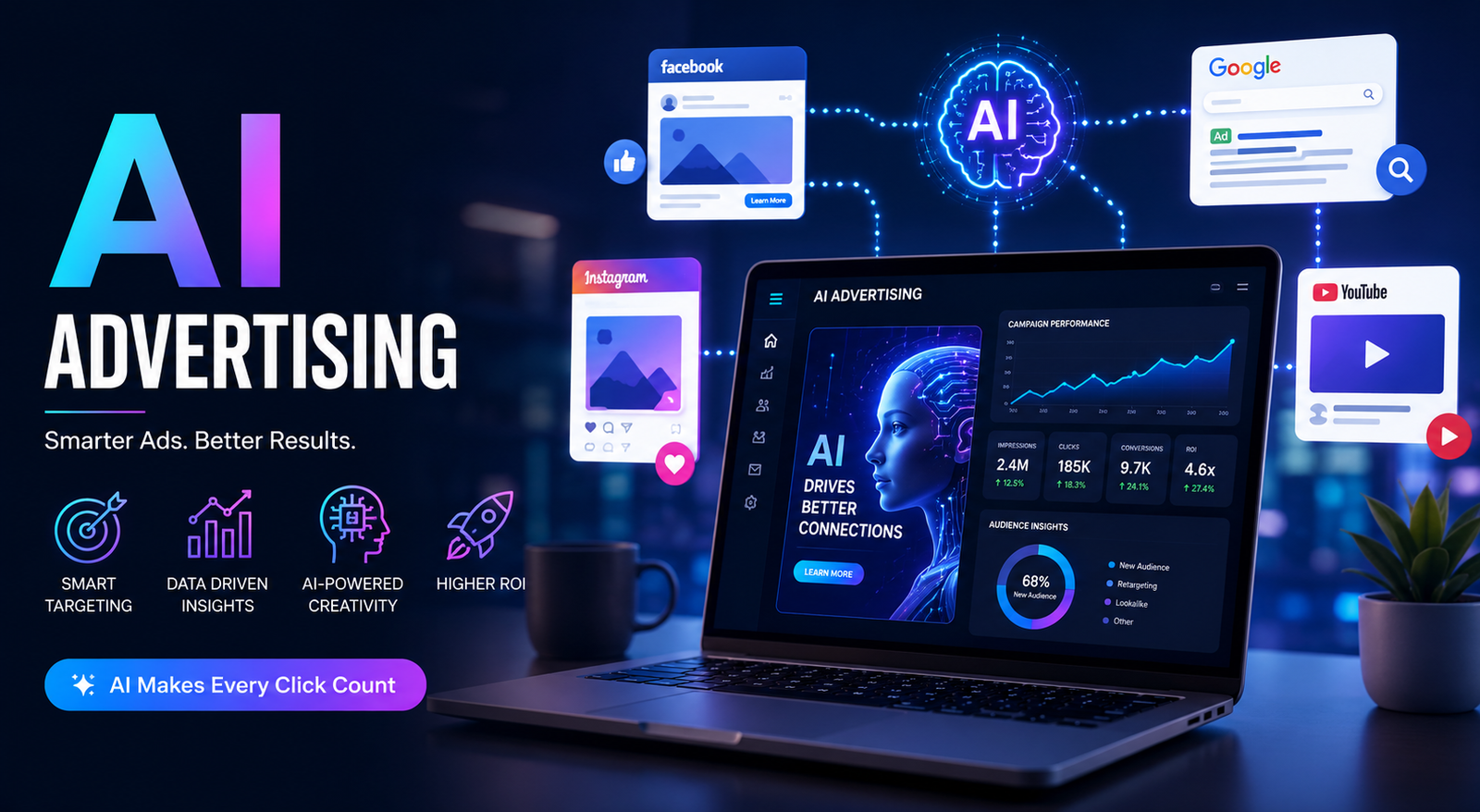
Advertising has always depended on understanding people, creating compelling messages, and placing those messages where they are most likely to generate results. What has changed is the speed and scale at which those tasks can now happen. AI advertising uses artificial intelligence to analyze data, identify audiences, generate creative assets, automate bidding, personalize messages, and optimize campaigns.
Instead of relying entirely on manual decisions, advertisers can use AI to process large amounts of information and identify patterns that would be difficult to find manually. At the same time, successful campaigns still need human strategy, brand knowledge, quality data, and careful oversight.
From an AI advertising generator that creates ad copy and visuals to automated campaign systems that optimize bids and audiences, artificial intelligence is becoming part of almost every stage of digital advertising. This guide explains how it works, where it provides value, practical AI in advertising examples, and how businesses can use it responsibly.
What Is AI Advertising?
AI advertising is the use of artificial intelligence and machine learning technologies to plan, create, deliver, personalize, and optimize advertisements. AI can analyze audience behavior, identify patterns, predict potential conversions, generate creative variations, and make real-time campaign adjustments.
Traditional advertising often requires marketers to manually research audiences, create variations, analyze reports, and adjust campaigns. AI can automate or accelerate many of these activities.
However, AI does not make advertising strategy unnecessary. The best results usually come from combining AI’s ability to process information quickly with human judgment, creativity, and business expertise.
AI Advertising vs. Traditional Advertising
| Traditional Advertising | AI Advertising |
| Manual audience research | AI-assisted audience analysis |
| Manual campaign optimization | Automated optimization |
| Limited creative variations | Large-scale creative variations |
| Periodic reporting | Continuous data analysis |
| Manual bidding adjustments | Automated bidding |
| Broad personalization | Data-driven personalization |
The key difference is not simply automation. AI allows advertisers to work with more data, test more possibilities, and respond to campaign signals faster.
How Does AI Advertising Work?
AI advertising generally works through several connected stages.
1. Data Collection and Analysis
AI systems analyze information such as website interactions, conversion activity, campaign performance, customer behavior, and contextual signals. The quality of this information matters because poor data can lead to poor recommendations.
2. Audience Identification
AI can identify patterns among users who are more likely to engage, convert, or purchase. Advertisers can use these insights to build more relevant audience strategies.
3. Creative Generation
Generative AI can help create headlines, descriptions, images, video concepts, product messaging, and creative variations. This makes it possible to produce and test more versions without manually creating every asset.
4. Automated Bidding and Placement
AI-powered advertising platforms can evaluate campaign signals and adjust bids or placements according to the campaign objective. This can reduce the amount of manual work required to manage large campaigns.
5. Continuous Optimization
After a campaign launches, AI can analyze performance signals and identify opportunities for improvement. Advertisers can then adjust targeting, creative, budgets, or offers based on actual results.
6. Measurement
AI can help organize performance information and identify trends across campaigns. Important business metrics still include conversion rate, cost per acquisition, revenue, and return on ad spend.
How Is AI Used in Advertising?
AI is not limited to one advertising function. It can support nearly the entire campaign lifecycle.
AI-Powered Audience Targeting
One of the most important applications is audience targeting. AI can analyze behavioral and contextual signals to help advertisers identify potential customers.
For example, an ecommerce company selling running shoes could use campaign data to identify audiences showing strong purchase intent instead of relying only on broad demographic categories.
Personalized Advertising
AI can help advertisers deliver different messages to different audience segments. A new visitor might see an introductory offer, while a returning customer could see messaging focused on a complementary product.
Personalization can improve relevance, but advertisers should still respect privacy requirements and avoid using sensitive information irresponsibly.
Automated Bidding
Automated bidding uses algorithms to determine bids according to campaign goals and available signals. Instead of manually changing bids throughout the day, advertisers can allow an advertising platform to make adjustments based on its optimization system.
AI Ad Copy Generation
An AI advertising generator can produce multiple versions of:
- Headlines
- Ad descriptions
- Calls to action
- Product benefits
- Social media copy
- Promotional messages
Human review remains essential because AI-generated copy can contain inaccurate claims, awkward wording, or messaging that does not match a company’s brand voice.
AI Image and Video Creation
Generative AI can also assist with advertising visuals. Businesses can use AI tools to brainstorm concepts, create variations, modify backgrounds, and develop visual ideas for campaigns.
This is particularly useful when advertisers need multiple creative concepts for testing.
Dynamic Creative Optimization
Dynamic creative optimization can combine different headlines, images, descriptions, and other elements to determine which combinations perform best for particular audiences.
Instead of creating one advertisement and assuming it will work for everyone, advertisers can test multiple variations and use performance signals to identify stronger combinations.
Predictive Analytics
AI can analyze historical and current campaign data to identify patterns and estimate likely outcomes. These insights can help advertisers decide where to focus their budget and which audiences or creatives deserve further testing.
Benefits of AI Advertising
When implemented correctly, AI advertising can provide several practical benefits.
Faster Campaign Management
AI can automate repetitive tasks that previously required substantial manual effort. This allows marketers to spend more time on strategy and creative decisions.
Better Personalization
AI can help advertisers develop messaging for different audiences rather than relying on one generic advertisement.
More Creative Testing
An AI system can help generate many variations quickly. More variations create additional opportunities to discover effective messaging.
Efficient Budget Optimization
AI-powered platforms can use campaign signals to help allocate advertising budgets toward opportunities that align with campaign goals.
Scalable Advertising
A small marketing team can use AI tools to perform tasks that would otherwise require considerably more time and resources.
Still, AI does not guarantee better performance. Results depend on factors such as the offer, landing page, creative quality, conversion tracking, audience, budget, and overall strategy.
AI Advertising Tools and Platforms
Businesses can use different tools depending on which part of advertising they want to improve.
| Tool Category | Main Purpose | Example Use |
| AI writing tools | Generate ad copy | Headlines and descriptions |
| AI design tools | Create visual assets | Social media ads |
| AI video tools | Produce video concepts | Short-form advertising |
| Advertising platforms | Campaign automation | Bidding and targeting |
| Analytics tools | Analyze performance | Conversion insights |
| AI marketing platforms | Multiple functions | Campaign workflows |
Some businesses only need an AI writing or design tool, while larger advertisers may benefit from integrated advertising platforms with automated targeting, bidding, and measurement.
AI in Advertising Examples
Looking at practical AI in advertising examples makes the technology easier to understand.
Ecommerce Example
An online clothing store could use AI to create several ad variations for a new product. The system could help generate different headlines, promotional messages, and visual concepts while campaign data determines which versions deserve additional testing.
SaaS Example
A software company could use AI to analyze lead-generation campaigns and identify which audience segments produce more qualified leads. AI could also assist with creating different messages for businesses at different stages of the buying journey.
Local Business Example
A local dental clinic could use AI to develop location-specific advertising messages, create multiple creative variations, and analyze which campaigns generate appointment requests rather than simply website visits.
B2B Example
A B2B company could use AI to help segment audiences, develop industry-specific messaging, and identify which campaigns are producing qualified prospects.
These examples demonstrate an important principle: AI in advertising is most valuable when it is connected to a specific business objective.
How to Create an AI Advertising Campaign
Creating an effective campaign does not require handing every decision to AI.
Step 1: Define the Goal
Decide whether the campaign is designed to generate sales, leads, awareness, app installs, or another measurable outcome.
Step 2: Understand the Audience
Identify your ideal customer, their needs, buying intent, objections, and preferred channels.
Step 3: Prepare Your Data
Make sure conversion tracking and campaign information are accurate. AI cannot compensate for fundamentally unreliable data.
Step 4: Create Advertising Assets
Use AI to brainstorm and produce ad copy, images, video concepts, and creative variations. Review everything before publishing.
Step 5: Select the Platform
Choose platforms based on where your audience actually spends time and what your campaign objective requires.
Step 6: Set the Budget
Determine how much you can spend and establish realistic performance expectations.
Step 7: Launch and Monitor
Don’t assume the campaign is successful simply because it receives clicks. Monitor conversions, costs, revenue, and lead quality.
Step 8: Test and Improve
Compare creative, audiences, offers, and landing pages. Use AI to identify patterns, but let business goals determine the final decisions.
AI Advertising vs. Human Advertising
The strongest approach is usually not AI versus humans. It is AI working alongside skilled marketers.
AI is particularly effective at processing large amounts of information, finding patterns, generating variations, and handling repetitive optimization tasks.
Humans remain important for positioning, brand voice, creative direction, ethical decisions, customer understanding, and strategic judgment.
For example, AI might produce 20 advertising headlines in seconds, but a marketer still needs to determine which headline accurately represents the product and speaks naturally to the target audience.
How Much Does AI Advertising Cost?
There is no single price for AI advertising. Costs can include advertising spend, AI software subscriptions, creative production, agency fees, analytics tools, and human management.
Free AI tools can help small businesses with brainstorming, copywriting, and basic creative tasks. Paid platforms may offer more advanced automation, integrations, analytics, and campaign features.
The most useful calculation is not simply the cost of an AI tool. Advertisers should evaluate the total campaign economics.
ROAS = Revenue ÷ Advertising Spend
CPA = Advertising Spend ÷ Conversions
A cheap AI tool is not necessarily valuable if the resulting advertising produces poor-quality customers.
AI Advertising Metrics to Track
Important metrics include:
- CTR: Measures how frequently people click an advertisement.
- CPC: Shows the average cost of each click.
- Conversion Rate: Measures how many visitors complete the desired action.
- CPA: Shows the average cost of acquiring a conversion.
- ROAS: Measures revenue generated relative to advertising spend.
- CAC: Estimates the cost of acquiring a customer.
- Customer Lifetime Value: Helps determine the long-term value of acquired customers.
The right metric depends on the business. A campaign designed for brand awareness should not necessarily be judged by the same standards as a direct ecommerce sales campaign.
Risks and Challenges of AI Advertising
AI advertising also introduces risks.
Poor-quality data can produce poor targeting decisions. AI-generated content can contain errors. Automated systems can make decisions that are difficult for marketers to fully understand. Privacy, bias, brand safety, and transparency also require careful consideration.
Another common problem is over-automation. Giving an AI system complete control without monitoring can make it difficult to understand why performance changes.
Human oversight should therefore remain part of the advertising process.
AI Advertising Best Practices
For better results, follow these principles:
- Start with a clear business objective.
- Use accurate conversion data.
- Give AI specific and useful inputs.
- Review AI-generated content before publishing.
- Maintain consistent brand guidelines.
- Test creative instead of assuming it will work.
- Monitor automated campaign changes.
- Focus on meaningful business outcomes.
- Protect customer and campaign data.
- Keep humans involved in important decisions.
The Future of AI Advertising
The next phase of AI advertising will likely involve deeper automation, increasingly personalized creative, AI-generated video, predictive optimization, and systems capable of managing more parts of a campaign.
Advertising platforms are also moving toward AI-powered campaign experiences, while advertisers are paying greater attention to transparency and responsible AI use.
Generative AI will continue to influence creative production, but the most valuable systems will likely combine generation with audience insights, campaign data, testing, and measurement.
The future is therefore less about replacing advertising professionals and more about giving them better tools to make faster, more informed decisions.
Conclusion
AI advertising is changing how businesses approach targeting, creative production, campaign optimization, and performance measurement. Its biggest advantage is the ability to process information and perform repetitive tasks at a scale that would be difficult to manage manually.
However, successful advertising still requires human expertise. AI should support strategy rather than replace it. Businesses that combine accurate data, strong creative ideas, thoughtful targeting, automated tools, and human oversight are better positioned to use artificial intelligence effectively.
Whether you are exploring AI for advertising free tools, comparing advertising platforms, or building a full AI-powered campaign, the best starting point is always the same: define the business goal, use reliable data, test carefully, and measure outcomes that actually matter.
Frequently Asked Questions About AI Advertising
What is AI advertising?
AI advertising is the use of artificial intelligence to create, target, personalize, deliver, analyze, and optimize advertisements. It can automate tasks such as bidding, audience analysis, creative generation, and campaign optimization.
How is AI used in advertising?
AI is used for audience targeting, personalized advertising, automated bidding, ad copy generation, image and video creation, predictive analytics, creative testing, budget optimization, and performance measurement.
What is an AI advertising generator?
An AI advertising generator is a tool that uses artificial intelligence to create advertising content such as headlines, descriptions, promotional copy, images, or other creative assets. Human review is still important before publishing generated content.
Can AI create advertisements for free?
Yes, some AI tools provide free features for generating advertising copy, ideas, images, or designs. However, advanced features may require a paid subscription, and advertising platforms still charge for media placement.
Is AI advertising better than traditional advertising?
AI advertising can make targeting, testing, analysis, and optimization faster, but it is not automatically better. Performance depends on campaign strategy, data quality, creative, offer, audience, and measurement.
What are some AI in advertising examples?
Examples include ecommerce stores using AI to generate product ad variations, SaaS companies analyzing lead quality, local businesses creating location-focused campaigns, and B2B companies developing industry-specific advertising messages.
Will AI replace advertising professionals?
AI is more likely to automate repetitive advertising tasks than completely replace skilled professionals. Human expertise remains important for strategy, creativity, brand management, ethical decisions, and interpreting business goals.
You May Also Read: AI SEO Services
